Don’t Let Your Guard Down: Top 5 Safety Tips for Operating a Bucket Lift Truck

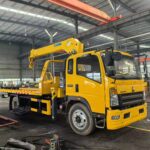
45Camión elevador de escalera M HOWO

Bucket lift trucks—also called aerial work platforms, cherry pickers, or boom trucks—are essential for construction, mantenimiento, utility work, and more. They allow workers to safely reach heights for tasks like tree trimming, power line maintenance, sign installation, and building repairs.

These trucks come in several specialized types to match different work environments: articulated bucket lift trucks have jointed booms for navigating around obstacles in tight or irregular spaces; carretillas elevadoras de escaleras feature straight, compact booms ideal for narrow aisles or quick vertical lifts; y telescopic aerial lift trucks extend linearly to reach maximum heights or long horizontal distances, suitable for larger-scale projects. Choosing the right type ensures both safety and efficiency on the job.

Sin embargo, these vehicles carry serious risks. Falls, electrocution, and tip-overs can be fatal—but most accidents are preventable with proper training, equipment checks, and safe operating procedures. The following five key safety tips provide practical guidance to protect operators and coworkers.


1. Conduct a Thorough Pre-Operation Inspection

Why it matters: Most equipment-related accidents start with unnoticed issues in the vehicle or boom system.

Checklist for inspection:

  • Vehicle: tires, chasis, hydraulic, combustible, and coolant systems
  • Boom and platform: hydraulic hoses, guarniciones, wiring, patas, platform integrity
  • Safety devices: emergency stop, lower controls, alarms, warning labels
  • Documentación: record your inspection; tag any issues asOut of Service”.

Quick Tip: Always check safety decals—they are operating instructions, not decorations. Never assume someone else has inspected the truck.

Note: If you find leaks, cracks, or loose pins, do not operate the truck until repairs are completed.


2. Position on Stable, Level Ground

Why it matters: Most tip-overs occur because trucks are set up on uneven or soft surfaces.

Safe setup steps:

  • Park on solid, level ground whenever possible
  • Deploy outriggers fully, following manufacturer instructions
  • Use pads or cribbing under outrigger floats on soft or paved surfaces
  • Chock wheels on sloping terrain
  • Check the level indicators if available

Quick Tip: Never move the truck with the boom elevated unless the unit is certified for mobile operation.

Reminder: Even a small slope can make the difference between a stable lift and a tip-over.


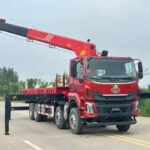
45Camión elevador de escalera M HOWO (4)

3. Maintain a Safe Distance from Power Lines

Why it matters: Contact with live electrical lines is one of the most lethal risks.

Safety measures:

  • Always assume lines are live unless confirmed otherwise by the utility company
  • Maintain a wide buffer zone; do not rely on visual estimation alone
  • Even non-metallic booms can conduct electricity if wet or dirty
  • If contact occurs, stay in the platform, warn others, and attempt to reverse controls calmly. Jumping is last-resort only in extreme emergencies

Quick Tip: Use a spotter to guide safe clearance distances near energized lines.


4. Wear and Use Fall Protection Equipment Properly

Why it matters: Platform guardrails alone cannot prevent falls.

Best practices:

  • Wear a full-body harness attached to the designated anchor point inside the platform
  • Inspect the harness and lanyard before each use for frays, cuts, or deformations
  • Connect immediately upon entering the platform
  • Lanyard should be as short as practical while allowing mobility
  • Never attach lanyards to guardrails or nearby structures

Tip: Properly secured fall protection can mean the difference between a minor incident and a fatal accident.


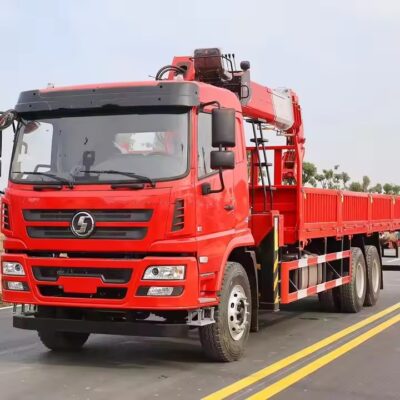
45Camión elevador de escalera M HOWO (2)

5. Know Your Equipment, Get Trained, and Respect Environmental Conditions

Why it matters: Even experienced operators can make mistakes if unfamiliar with the truck or environmental hazards.

Key points:

  • Only trained and authorized personnel should operate bucket lift trucks
  • Know the capacidad de carga, including workers, herramientas, and materials
  • Keep the platform organized—avoid clutter that could cause trips or tipping
  • Monitor surroundings: overhead obstacles, nearby structures, traffic
  • Respect weather conditions: high winds, lluvia, ice, or snow can destabilize the boom
  • Never use ladders, boxes, or planks inside the platform to gain extra height
  • Park to allow safe departure without reversing unnecessarily

Quick Tip: Treat every job as a high-risk scenario—plan your approach and exits before lifting.


Conclusión

Bucket lift trucks are powerful tools that make high-elevation work safer—but only if used with respect, preparation, and vigilance.

By following these five safety tips:

  1. Conduct thorough inspections
  2. Position on stable ground
  3. Maintain distance from power lines
  4. Use fall protection correctly
  5. Operate with training and awareness

…operators protect themselves, their coworkers, and the people around the work site.

Remember: Safety is not optional. With preparation and attention to detail, every worker can arrive safely on the job and return home safely at the end of the day.

Deja una respuesta

Su dirección de correo electrónico no será publicada. Los campos obligatorios están marcados *