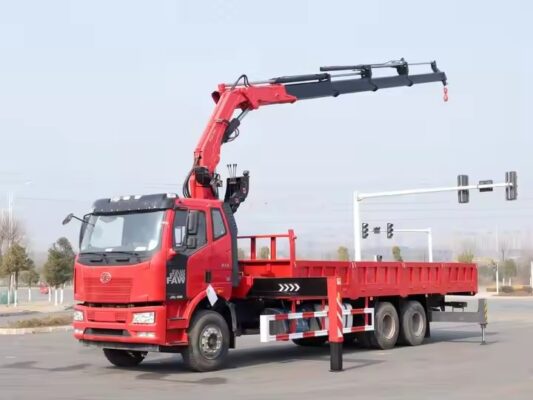
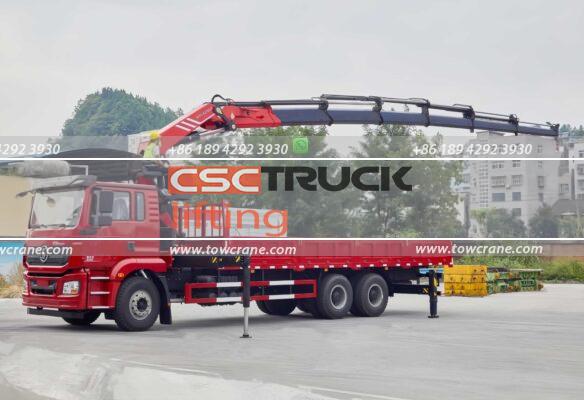
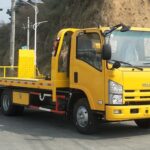
-A giltzapeko garabia, also called a loader crane, is a versatile type ofkamioian muntatutako garabiathat is widely used in construction, logistika, and municipal projects. Unlike traditional straighttelescopic cranes, a knuckle boom crane features articulated (jointed) boom sections that fold like a finger. This unique design allows the crane to operate in tight spaces while maintaining strong lifting performance.
In this guide, we’ll explain how agiltzapeko garabiaworks, what powers it, and why it has become essential in construction, logistika, utility services, and municipal projects.
The Core Principle: Hydraulic Power and Articulated Movement
At its core, a giltzapeko garabiaoperates through ahydraulic systemcombined with amulti-joint boom structure.
The truck’s engine drives a hydraulic pump through a Power Take-Off (PTO) system. This pump pressurizes hydraulic fluid and sends it into cylinders located along the boom. When hydraulic pressure increases, the cylinders extend or retract, moving different sections of the crane.
Because hydraulics allow smooth and controlled force distribution, the operator can lift, rotate, extend, and lower heavy loads with precision. This system delivers strong lifting capacity without requiring a massive crane structure.
The defining feature is the “knuckle” joint between boom sections. Instead of one straight arm extending outward, the crane has at least two articulated arms connected by hinges. This allows the crane to:
Lift vertically
Reach outward horizontally
Bend over obstacles
Fold compactly for transport
This combination of hydraulic strength and articulated flexibility is what makes thegiltzapeko garabiaso versatile.
How the Boom Structure Functions in Real Operation
The boom structure typically consists of:
A base column mounted to the truck chassis
An inner boom (primary lifting arm)
An outer boom (secondary arm connected by a joint)
Optional telescopic extensions for extended reach
When lifting a load, the inner boom raises the weight from the ground. The outer boom adjusts the angle and positioning. If additional reach is required, telescopic sections extend outward without increasing the crane’s transport length.
This multi-angle movement allows operators to position materials with high accuracy — especially useful for placing steel beams, glass panels, roofing materials, or utility poles.
Unlike straight boom cranes, which primarily extend outward in a single line, knuckle boom cranes can maneuver around buildings, fences, and other job site obstacles.
Stability and Safety During Lifting
Safety is one of the most critical aspects of operating a knuckle boom crane. Because the crane is mounted on a truck chassis, proper stabilization is essential before any lifting begins.
Before the operation, hydraulic outriggers extend from both sides of the truck to create a wider and more secure support base. These stabilizers transfer the load weight directly to the ground and significantly reduce the risk of tipping. The larger the lifting radius and load weight, the more important proper outrigger deployment becomes.
Modernknuckle boom cranesare equipped with advanced safety technologies designed to monitor and control lifting conditions in real time. These systems typically include load moment indicators (LMI), overload protection mechanisms, and electronic stability controls. Sensors continuously calculate boom angle, extension length, and load weight to ensure the crane operates within safe working limits.
If the system detects a potential overload or unsafe configuration, it automatically restricts certain movements to prevent accidents. This intelligent monitoring greatly enhances job site safety and reduces the likelihood of equipment damage or operator error.
Proper ground assessment, full outrigger extension, and adherence to load charts remain essential best practices. Even with advanced technology, safe lifting ultimately depends on trained operators and strict compliance with operational guidelines.
Step-by-Step: What Happens During a Typical Lift?
Although operation may vary depending on the model, the general process follows these steps:
First, the truck is parked on stable ground and the outriggers are fully deployed. The hydraulic system is activated through the PTO. The operator then rotates the crane toward the load and extends the boom sections.
Using either manual controls or a wireless remote control, the operator positions the hook or attachment precisely over the material. The load is lifted slowly and smoothly, guided to its destination, and placed accurately. After completion, the boom retracts and folds neatly behind the truck cab for transport.
This folding capability is one of the key advantages ofknuckle boom cranes. When not in use, they occupy minimal space and maintain road safety compliance.
Why Knuckle Boom Cranes Are So Popular
The growing demand forknuckle boom cranesis driven by efficiency and versatility. A single truck can transport materials and unload them independently, eliminating the need for separate lifting equipment.
Compared to traditional mobile cranes, knuckle boom cranesoffer:
Greater flexibility in confined urban spaces
More precise load placement
Faster setup time
Lower overall operating costs
Compact transport dimensions
They are widely used in construction, logistika, heavy equipment transport, electrical utility work, and municipal infrastructure projects.
Beraz, how does a knuckle boom crane work? It operates by combining hydraulic power with an articulated boom structure, enabling controlled, multi-directional lifting from a compact truck-mounted system.
This engineering design delivers the ideal balance between power, malgutasuna, and efficiency — making it one of the most practical lifting solutions for modern industries.