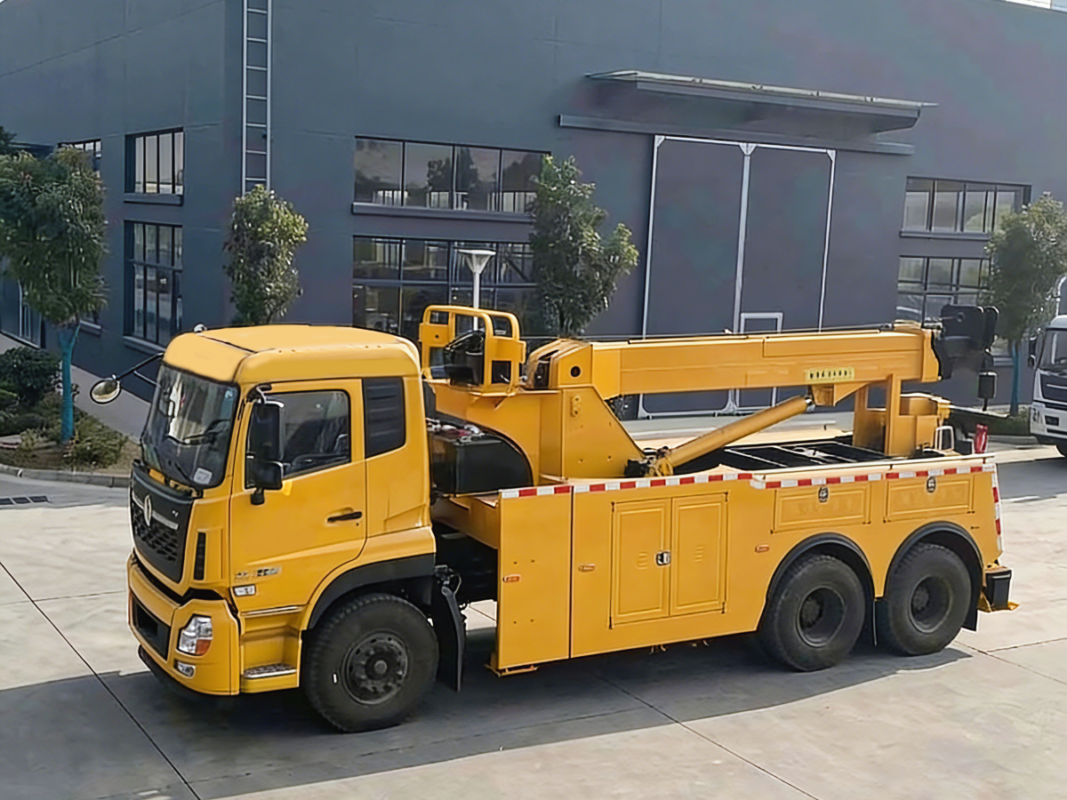
For decades, the sight of a conventionaldépanneusehooking up a stranded sedan was enough to clear a roadside. But as Australia’s freight and construction industries have grown, so too have the demands placed on recovery operators. Aujourd'hui, a new king sits atop the towing world: le dépanneuse rotateur.
Across Sydney, Melbourne, and the nation’s major freight corridors, these multi-axle giants are becoming an increasingly common—and essential—sight. With their distinctive rotating booms and massive lifting capacity, rotator trucks are redefining what’s possible in heavy vehicle recovery.
What Is a Rotator Tow Truck?
Unlike a traditional tow truck with a fixed boom, a rotator features a hydraulic boom mounted on a rotating turret. This allows operators to lift, pull, and position heavy loads from virtually any angle without needing to reposition the truck itself.
Think of it as a mobile crane fused with a tow truck. This rotating capability is a game-changer when recovering overturned semis, jackknifed B-doubles, or heavy machinery from tight construction sites. Where a conventional wrecker might require careful repositioning—or multiple trucks—a single rotator can often get the job done faster and safer.
Power That Commands Respect
Modern rotator trucks are engineering marvels. Some of the largest models, such as the Miller Century 1150R, boast lifting capacities exceeding 50 tonnes, with extendable booms reaching up to 50 feet. At the extreme end of the scale, the NRC Industries 80-ton rotator holds the title of the world’s largest, capable of handling even the most extreme recovery operations.
In the Australian context, this level of capability is increasingly necessary. With B-doubles and road trains plying the nation’s highways, and massive mining and construction equipment operating on job sites, recovery operators need equipment that can handle the heaviest loads safely and efficiently.
Why Rotators Are Taking Over in Australia
Several factors are driving the rise of rotator trucks across the Australian towing industry.
1. The Growth of Heavy Freight and Construction
Australia’s freight task continues to grow, with more semi-trailers, B-doubles, and oversized loads on the road than ever before. When one of these vehicles is involved in an accident or suffers a mechanical failure, conventional recovery methods often fall short.
Rotators are purpose-built for exactly these scenarios. Their ability to lift and right overturned trucks, clear multi-vehicle accident scenes, and transport damaged heavy vehicles makes them indispensable for major incident response.
Construction sites present another major demand. Concrete trucks, pump trucks, and heavy earthmoving equipment can become stuck or break down in difficult terrain. Rotators can reach over obstacles, lift from awkward angles, and extract equipment without causing further damage to the site or the machinery.
2. Efficacité et vitesse
Time is money—nowhere more so than on a blocked highway or a delayed construction site. Rotator trucks dramatically reduce recovery times.
Because the boom rotates a full 360 degrés, operators can position the truck once and then work from the optimal angle. This eliminates the need for multiple repositioning maneuvers and allows for quicker clearance of accident scenes. For freight operators, every minute of downtime translates to lost revenue, so faster recovery is a major advantage.
3. Sécurité
Recovering a rolled semi-trailer on a busy highway is inherently dangerous. Rotator trucks enhance safety in several ways:
Stabilité: Modern rotators feature advanced outrigger and stabilizer systems that provide an exceptionally stable lifting platform. Remote Operation: Many rotator functions can be operated remotely, allowing the operator to maintain a safe distance during the most dangerous phases of a recovery. Reduced Traffic Exposure: Faster recovery times mean roads are closed for shorter periods, reducing the risk of secondary accidents involving passing motorists.
4. Versatility Across Industries
While rotators are essential for highway accident recovery, their utility extends far beyond roadside assistance. These trucks are increasingly used for:
Industrial Equipment Transport: Moving cranes, excavators, and other heavy machinery between job sites. Mining Operations: Recovering disabled haul trucks and support vehicles in remote and rugged terrain. Urban Construction: Extracting concrete trucks and pumpers from tight city sites where maneuverability is limited.
The Cost of Playing at the Top Level
Owning and operating a rotator truck is a significant investment. These are complex, highly specialized machines with price tags to match—often several times that of a conventional heavy-duty wrecker.
Cependant, for towing companies that serve the heavy transport, construction, and mining sectors, the investment is increasingly justified. The ability to handle high-value recoveries, command premium rates, and win contracts that require specialized equipment makes rotators a strategic asset.
The Future of Rotators in Australia
As the Australian economy continues to rely on road freight and major infrastructure projects, the demand for rotator trucks is only likely to increase. Several trends are shaping the next generation of these machines:
Electrification: While heavy-duty electric tow trucks are still emerging, the industry is watching developments closely. Electric rotators could offer lower operating costs and reduced emissions for urban-based operations. Enhanced Connectivity: Future rotators are likely to feature advanced diagnostic and communication systems, allowing operators to receive detailed vehicle data before arriving at a scene. Automated Features: Remote-controlled booms, automated outrigger deployment, and sensor-assisted loading are already appearing in some models, improving safety and precision.
Conclusion
Rotator trucks have moved from a niche specialty to a central pillar of Australia’s heavy-duty towing industry. Their combination of raw power, précision, and efficiency makes them uniquely suited to the challenges of modern freight and construction recovery.
For fleet managers, logistics operators, and construction companies, knowing that a capable rotator is available when things go wrong provides critical peace of mind. And for the towing operators who have invested in these machines, the rotator represents not just a tool, but a statement: when the job is too big for anything else, they have the equipment that gets it done.
As Australia’s roads get busier and its machinery gets larger, the rotator’s moment in the spotlight is only just beginning.