

Bucket Truck

Bucket Truck
Telescopic Aerial Lift Truck
Telescopic Aerial Lift Truck

Telescopic Aerial Lift Truck

Telescopic Aerial Lift Truck

Telescopic Aerial Lift Truck

Telescopic Aerial Lift Truck

Telescopic Aerial Lift Truck

Telescopic Aerial Lift Truck

Telescopic Aerial Lift Truck

Telescopic Aerial Lift Truck
Telescopic Aerial Lift Truck
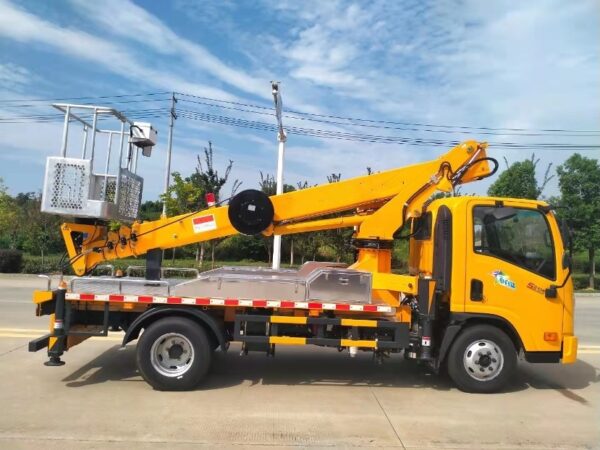
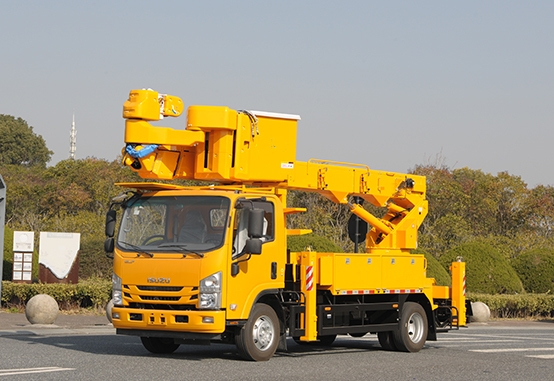
A telescopic aerial lift truck, also known as a straight boom lift truck or telescopic bucket truck, is a specialized vehicle designed to safely elevate workers and equipment to high, vertically oriented work areas using a straight, multi-section hydraulic boom. Unlike articulating (knuckle) boom lifts that bend around obstacles, telescopic booms extend in a straight line—much like a telescope—providing maximum vertical reach and exceptional height capability. These trucks are essential for utility maintenance, tree care, kumanga, telecommunications, and any industry requiring reliable, direct access to elevated work areas where vertical clearance is the primary consideration.Key Features of Telescopic Aerial Lift Trucks
- Straight Telescopic Boom The defining feature of a telescopic aerial lift is its multi-section hydraulic boom that extends and retracts in a straight line. This design maximizes vertical reach and provides a stable, predictable lifting path, making it ideal for tasks that require direct vertical access without lateral maneuvering.
- Work Platform (Bucket) The bucket or platform is typically mounted at the boom’s end and designed to hold one or two workers plus tools. Features include guardrails, harness attachment points, non-slip surfaces, ndi, in insulated models, dielectric liners for electrical safety.
- Hydraulic Control System Hydraulic controls provide smooth, precise boom extension and retraction. Many models feature proportional controls that allow variable speed operation, enabling operators to position the platform with accuracy. Both bucket-mounted and ground-level controls are common.
- Outriggers and Stabilizers Hydraulically deployed outriggers extend from the truck chassis to provide stability during operation. These stabilizers prevent tipping and ensure a secure working platform, particularly when the boom is extended to its maximum height or operated on uneven terrain.
- Compact Transport Configuration When not in use, the telescopic boom retracts to a compact length, reducing the vehicle’s overall size for safe road travel and convenient storage. This allows the truck to maneuver through urban streets and park in standard parking spaces.
- Safety Systems Telescopic aerial lifts are equipped with multiple safety features, including overload sensors, tilt alarms, emergency descent systems, and interlock mechanisms that prevent operation unless outriggers are properly deployed. Insulated models also include dielectric testing ports and insulation monitoring systems.
Applications of Telescopic Aerial Lift Trucks
- Utility Line Maintenance Telescopic bucket trucks are the standard equipment for maintaining power lines, transformers, and distribution equipment. Insulated models allow crews to work safely on energized lines, minimizing service disruptions.
- Streetlight and Traffic Signal Maintenance Municipalities use telescopic aerial lifts to repair and replace streetlights, traffic signals, and pedestrian crossing lights. The straight boom provides direct vertical access to lighting poles and overhead fixtures.
- Tree Care and Arboriculture Telescopic lifts are used for tree trimming and removal where vertical access to the canopy is needed. Their ability to reach significant heights makes them suitable for large trees in parks, residential areas, and along roadways.
- Signage Installation and Maintenance Contractors use telescopic bucket trucks to install, repair, and maintain billboards, large commercial signage, and directional signs at highway interchanges and urban intersections.
- Construction and Building Maintenance Telescopic aerial lifts provide access to high building facades, roof lines, and structural elements for construction, kuyendera, window cleaning, and exterior repairs. Heavy-duty models are capable of reaching multi-story buildings.
- Telecommunications Crews use telescopic lifts to access cell towers, antennas, and rooftop equipment for installation, kukonza, and troubleshooting. The straight boom provides stable, direct access to elevated telecom infrastructure.
- Ntchito Zadzidzidzi During disaster response or emergency repairs, telescopic aerial lifts provide rapid access to elevated areas for rescue operations, utility restoration, and infrastructure assessment.