Crane tow trucks—especially heavy-dutyrotator wreckers—are some of the most impressive machines on the road. Their ability to lift, rotate, and precisely position multi-ton vehicles depends on one critical system: hydraulics. At the center of that system arehydraulic cylinders, which power the extension and retraction of the boom.
But how exactly do these cylinders work, and why are they so effective for heavy lifting? Let’s break it down.
The Basics of Hydraulic Power
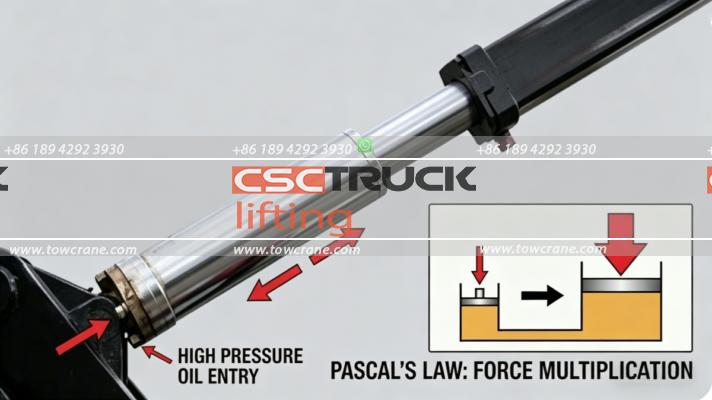
Hydraulic systems operate based on a simple principle from physics: Pascal’s Law, which states that pressure applied to a confined fluid is transmitted equally in all directions.
In practical terms, this means:
A small force applied to hydraulic fluid can be transformed into a much larger force.
This allows machines like crane tow trucks to lift extremely heavy loads with precision and control.
A typical hydraulic system in a tow truck includes:
A hydraulic pump
Hydraulic fluid (oil)
Control valves
Hydraulic cylinders
Anatomy of a Hydraulic Cylinder
To understand boom movement, you need to understand the cylinder itself. A hydraulic cylinder consists of:
Cylinder barrel– the main body that holds the fluid
Piston– moves back and forth inside the barrel
Piston rod– connects the piston to the boom
Seals– prevent fluid leaks and maintain pressure
Ports– allow hydraulic fluid to enter and exit
When pressurized oil enters one side of the cylinder, it pushes the piston, creating linear motion.
How the Boom Extends
Extending the boom is a controlled, step-by-step hydraulic process:
The operator activates the control lever.
The hydraulic pump forces oil into the base end of the cylinder.
Pressure builds inside the cylinder.
The piston is pushed outward.
The piston rod extends, pushing the boom forward.
In telescopic booms, this process may happen inmultiple stages, where:
One section extends first
Then the next section follows
Allowing the boom to reach significant lengths
This is how rotator tow trucks can extend their reach to recover vehicles from difficult positions—like down embankments or across barriers.
How the Boom Retracts
Retraction is essentially the reverse process:
Hydraulic fluid is redirected to the opposite side of the piston.
Oil from the first chamber flows back to the reservoir.
The piston moves inward.
The boom sections slide back into each other.
In many systems, gravity and load weight also assist in retraction, reducing the amount of energy required.
Multi-Stage Telescopic Systems
Modern crane tow trucks often usetelescopic booms, which consist of multiple nested sections.
Hydraulic cylinders in these systems may:
Extend all sections simultaneously (synchronized systems)
Or extend them sequentially (stage-by-stage systems)
Some advanced setups use:
Cable-and-pulley systemsinside the boom
Ormultiple internal cylinders
This allows for:
Longer reach
Compact storage
Better load distribution
Control and Precision
One of the biggest advantages of hydraulics isprecision control.
Operators can:
Extend the boom slowly for delicate recoveries
Stop movement instantly
Adjust the position millimeter by millimeter
This is crucial when:
Recovering overturned trucks
Lifting vehicles from tight urban spaces
Avoiding further damage during recovery
Safety Mechanisms
Because these machines handle extreme loads, safety is critical. Hydraulic systems include:
Relief valves– prevent overpressure
Load-holding valves– keep the boom from collapsing if pressure is lost
Check valves– control fluid direction
Stabilizers (outriggers)– keep the truck from tipping
Without these safeguards, extending a boom under heavy load would be extremely dangerous.
Why Hydraulics Are Ideal for Tow Trucks
Hydraulic cylinders are used instead of electric or mechanical systems because they offer:
Massive Force Output
Hydraulics can generate enormous lifting power in a compact system.
Smooth Motion
No jerky or sudden movements—essential for handling damaged vehicles.
Reliability
Fewer moving parts compared to complex mechanical linkages.
Scalability
Systems can be designed for light-duty trucks or massive rotators.
Practical Application Cases
Imagine a heavy-duty rotator recovering an overturned semi-truck:
The boom extends outward using hydraulic cylinders
It rotates into position
The winch line is attached
The operator carefully lifts and rotates the load
Every movement—extension, lifting, positioning—is powered and controlled by hydraulics.
Conclusion
Hydraulic cylinders are the driving force behind a cranetow truck’s ability to extend and retract its boom. By converting fluid pressure into controlled linear motion, they allow operators to handle massive loads with precision, safety, and efficiency.
Next time you see a crane tow truck in action, remember: What looks like effortless movement is actually the result of carefully engineered hydraulic power working behind the scenes.