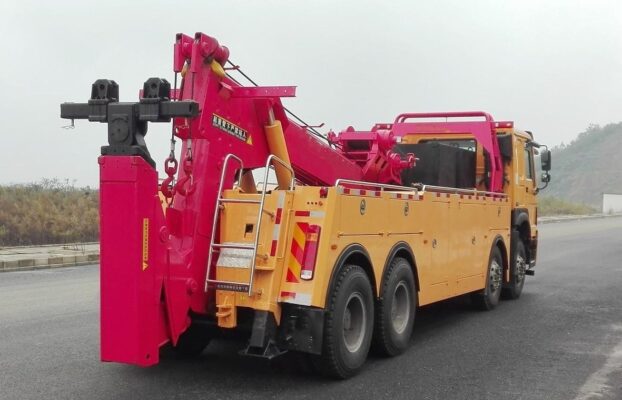
When aheavy-duty wreckerarrives at an accident scene—especially one involving overturned trucks or large vehicles—the most critical step isn’t lifting. It’s stabilizing. Before any boom moves or cables tighten, operators deployoutriggers, the hidden heroes that make safe recovery possible.
ਇਸ ਲੇਖ ਵਿਚ, we’ll break down how outriggers work, why they’re essential, and what happens if they’re not used properly.
What Are Outriggers?
Outriggers are extendable support legs mounted on the sides of a wrecker. They are designed to:
Increase the vehicle’s footprint
Distribute weight more evenly
Prevent tipping during lifting operations
Typically, heavy wreckers havefour outriggers—two on each side—equipped withsteel padsthat press firmly into the ground.
Think of them as the “foundation” of the recovery operation.
Why Stability Matters in Heavy Recovery
Lifting a multi-ton vehicle isn’t just about strength—it’s about balance.
The problem:
When a boom extends outward and lifts a load, it creates atipping force (moment) that can destabilize the truck.
Without outriggers:
The center of gravity shifts outward
The truck can lean—or even tip over
Recovery becomes dangerous or impossible
With outriggers:
The load is transferred to a wider base
Forces are distributed safely into the ground
The truck remains stable even under extreme loads
In short: no outriggers = no safe lift
How Outriggers Work
The system is powered by hydraulics and operates in a few steps:
Step-by-step:
Extension Outriggers slide outward from the chassis to increase the width
Deployment Hydraulic cylinders push the legs downward
Ground contact Steel pads (often with mats) press firmly into the surface
Load transfer The truck’s weight shifts from wheels to outriggers → Wheels may even lift slightly off the ground
Key Components of an Outrigger System
Hydraulic cylinders
Provide the force to extend and lower the outriggers
Outrigger beams
Horizontal arms that widen the stance
Footpads (or pads/mats)
Distribute pressure and prevent sinking
Control system
Allows operators to level the truck precisely
Real-World Factors That Affect Stability
Even with outriggers deployed, operators must consider:
Ground conditions
Soft soil or asphalt can collapse under pressure
Mats or cribbing may be required
Load angle
Side lifts are more dangerous than rear lifts
Greater extension = greater tipping force
Boom length
The farther the boom extends, the higher the leverage
Stability isn’t just equipment—it’s operator judgment.
What Happens If Stabilization Is Ignored?
Failure to properly deploy outriggers can lead to:
Equipment tipping or rollover
Dropped loads
Severe injury or damage
Roadway hazards
In the recovery industry, improper stabilization is one of theleading causes of accidents.
ਸਿੱਟਾ: The Unsung Backbone of Recovery
Outriggers may not be as visible as the boom or winch, but they are absolutely essential. Every successful heavy recovery operation depends on a stable base before any lifting begins.
The takeaway is simple: Strength lifts the load—but stability makes it possible.
If you are looking for integrated wreckers with heavy‑duty outriggers and advanced stabilization systems, contact us. CSCTRUCK towcraneoffers a range of tow trucks andloader cranes—all engineered for stability, safety, and performance in the most demanding recovery environments.