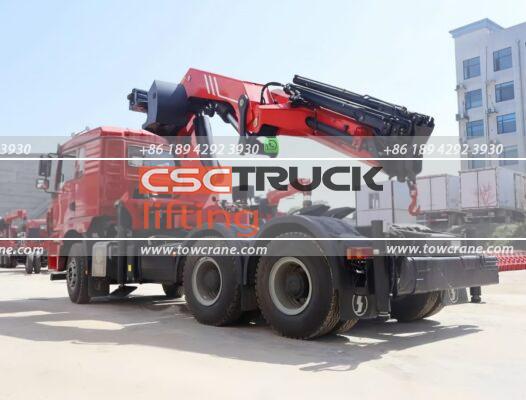
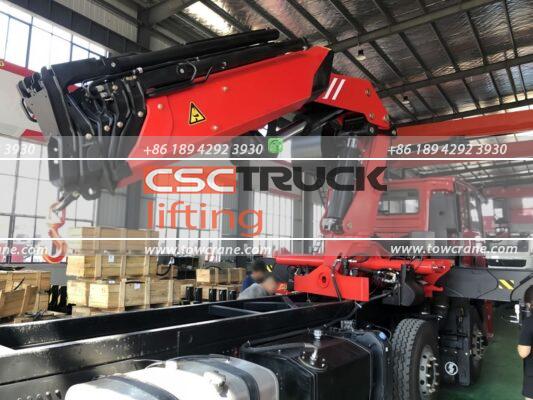
Truck-mounted cranes are categorized based on the number of axles, such as two-axle, three-axle, four-axle, and so forth. For the same number of axles, the wheelbase can vary, either being larger or smaller. So, what exactly are the implications of the wheelbase on the performance ofCrie ọkọ oju-omi kekeres? Specialists in Crie ọkọ oju-omi kekeres inform us that the wheelbase of aCrie ọkọ oju-omi kekereis intricately linked to the performance of the entire vehicle, as the wheelbase determines the position of the center of gravity of the Crie ọkọ oju-omi kekere. Consequently, if the wheelbase of theCrie ọkọ oju-omi kekereundergoes a change, the entire vehicle configuration must be reorganized, particularly the dimensions of the transmission system and the body. The parameters of the springs and shock absorbers within the suspension system need to be recalibrated, the size of the trapezoidal tie rods in the steering system needs adjustment, and simultaneously, a change in the wheelbase will also cause alterations in the distribution of axle loads on the front and rear axles.
The most immediate impact of the wheelbase on theCrie ọkọ oju-omi kekereis the length of the vehicle body, which further influences the interior space. Fun apẹẹrẹ, the wheelbase of a blue-plateCrie ọkọ oju-omi kekereis typically around 3300mm. Due to this relatively shorter wheelbase, the space in its rear seat is relatively confined. In contrast, the wheelbase of a yellow-plateCrie ọkọ oju-omi kekereis generally above 4000mm. With this longer wheelbase, the space in its rear seat is significantly more generous. Therefore, the wheelbase plays a decisive role in determining the length, available space, and comfort level within the vehicle body.
The wheelbase also has a considerable bearing on the passability and stability of theCrie ọkọ oju-omi kekere. ACrie ọkọ oju-omi kekerewith a short wheelbase benefits from a shorter overall length, lighter mass, smaller turning radius, and passage radius. This enables it to navigate through relatively narrow sections with greater ease. Sibẹsibẹ, the drawback of an overly short wheelbase is that it compromises the vehicle’s maneuverability and stability. Ti a ba tun wo lo, aCrie ọkọ oju-omi kekerewith a large wheelbase has a longer overall length and greater mass. Its center of gravity is located farther from the support points, resulting in relatively stable driving and a reduced likelihood of rollover incidents. Nevertheless, such a configuration comes with a larger turning radius, a larger reversing blind area at the rear, increasing the risk of accidents, and making it less suitable for narrow road conditions.
The size of the wheelbase also has an impact on the installation of the crane on theCrie ọkọ oju-omi kekere, which is particularly evident in double-steering axleCrie ọkọ oju-omi kekeres. Fun apere, in the case of small three-axle and front-four-rear-eightCrie ọkọ oju-omi kekeres, when installing the crane on these two types of vehicles, the outrigger component of the crane must be positioned between the two steering axles. If the wheelbase between the steering axles is excessively short, it becomes impossible to lower the outriggers, especially for large-tonnage cranes, which are typically rear-mounted.
The wheelbase is a critical factor that affects multiple aspects of theCrie ọkọ oju-omi kekere‘s performance. It influences the vehicle’s handling, stability, interior space, and the installation of the crane itself. A well-chosen wheelbase can optimize theCrie ọkọ oju-omi kekere‘s capabilities to suit specific operational requirements and working conditions. When purchasing a Crie ọkọ oju-omi kekere, potential buyers must carefully consider the wheelbase in relation to the intended use of the vehicle. If theCrie ọkọ oju-omi kekereis primarily intended for operations in confined spaces or areas with narrow roads, a shorter wheelbase might be more appropriate to ensure maneuverability. Sibẹsibẹ, if stability and a larger working platform are priorities, a longer wheelbase could be the better choice.
The decision regarding the wheelbase should also take into account factors such as the weight and size of the loads to be lifted, the frequency and nature of the lifting operations, and the terrain and road conditions in which the vehicle will be operating. A comprehensive assessment of these factors can lead to a more informed choice of wheelbase, thereby maximizing the efficiency and safety of theCrie ọkọ oju-omi kekerein its intended application.
Ni paripari, the wheelbase is not just a simple specification but a key determinant of the overall performance and functionality of theCrie ọkọ oju-omi kekere. Paying close attention to this aspect during the purchasing process is essential to ensure that the vehicle meets the operational needs and expectations of the user.