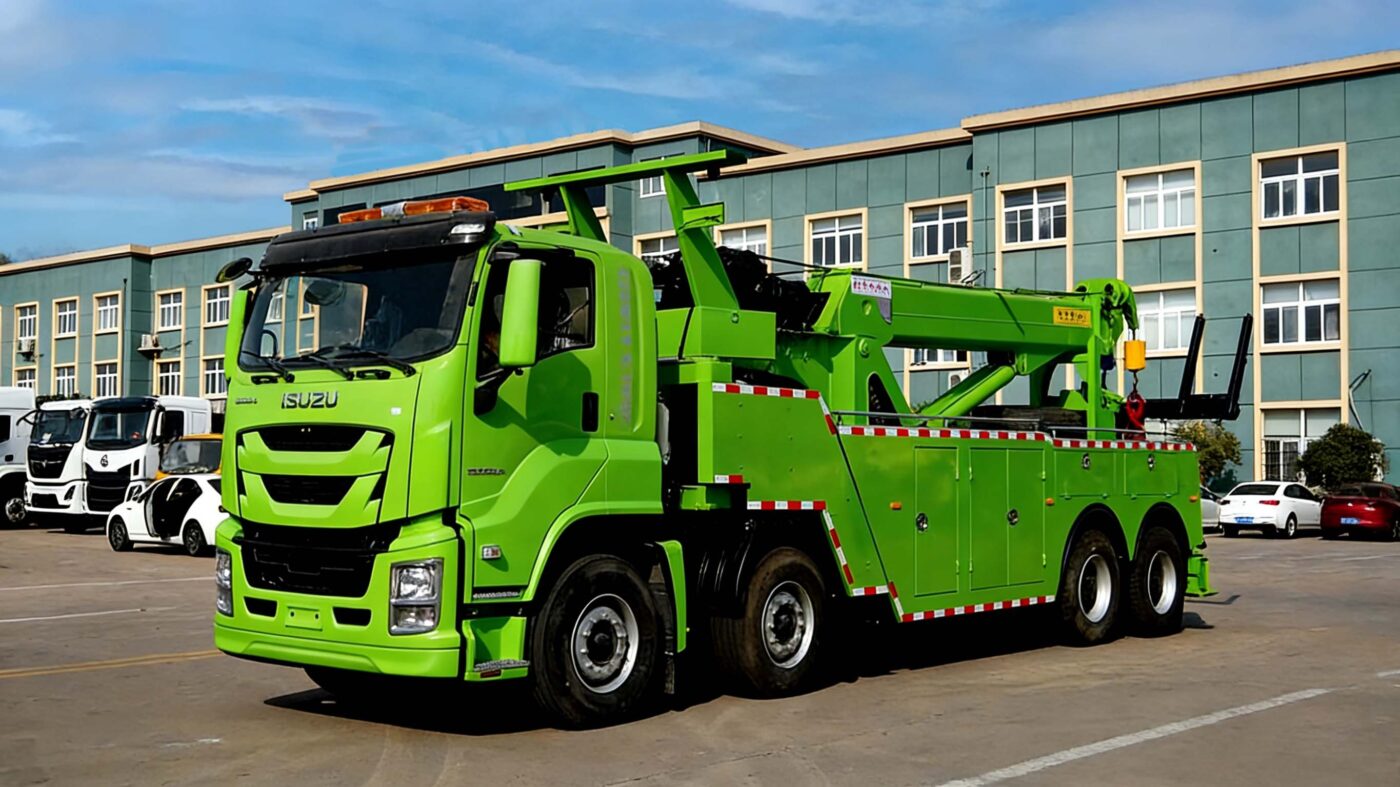
In the world ofheavy-duty towing and recovery, equipment design is no longer just about lifting capacity. The evolution fromtraditional wreckers ki na rotator tow truckshas fundamentally changed how recovery operators approach difficult recoveries, roadside safety, and operational efficiency. What once required multiple trucks, road closures, and hours of labor can now often be handled by a single highly specialized recovery unit.
The difference comes down tostructural engineering.
Understanding howrotator tow trucksdiffer fromconventionalwreckersreveals why they are increasingly becoming the preferred solution for complex recoveries involving overturned semis, bridge incidents, construction equipment, and confined urban environments.
What Is a Conventional Tow Truck?
Traditionalheavy-duty wreckersare built around afixed boom systemmounted to the rear of the chassis. The boom typically pivots vertically and may extend telescopically, but its lateral movement is limited. To position the lifting point correctly, operators usually need to align the entire truck with the recovery target.
For decades, this design served the towing industry effectively. Conventional wreckersare reliable, durable, and generally less expensive to purchase and maintain. They remain widely used for:
Highway towing
Standard semi-truck recovery
Fleet transport
Accident clearance
Medium-complexity recoveries
Ia,, na fixed-boom designintroduces operational constraints in tight spaces or high-risk environments.
The Rise of the Rotator Tow Truck
Rotator tow trucksrepresent a major engineering leap inheavy recovery equipment. Instead of relying on a fixed rear boom, a rotator features a hydraulically poweredrotating turretcapable of turning 360 degrees.
This seemingly simple change dramatically alters the recovery strategy.
Rather than repositioning the entire truck repeatedly, operators can stabilize the vehicle once and rotate the boom toward the recovery object. Modern rotators also feature significantly higher lifting capacities, advanced outriggers, and sophisticatedload management systems.
The result is greater precision, improved safety, and reduced recovery time.
Structural Design Differences That Matter
1. Boom Mobility and Rotation
The most obvious distinction isrotational capability.
A conventional wrecker’s boom primarily moves up and down. In contrast, arotator boomrotates horizontally while extending and lifting simultaneously. This allows operators to performside recoveries, elevated lifts, and complexwinching operationswithout moving the chassis.
This capability is especially valuable when:
Vehicles are trapped in ditches
Recovery access is limited
Traffic lanes must remain partially open
Recoveries occur on bridges or embankments
Heavy equipment must be lifted vertically
In urban areas where space is limited, the rotator’s flexibility can eliminate the need for additional cranes or support vehicles.
2. Outrigger Engineering and Stability
Rotator tow trucksare designed with far more advancedstabilization systems.
Traditional wreckers use outriggers primarily for balance during lifting operations. Rotators, however, rely heavily onmulti-stage hydraulic outriggersengineered to handle extreme side-loading forces created during 360-degree lifting.
Thisstructural reinforcementallows rotators to safely execute lifts at challenging angles while maintaining chassis stability.
The engineering challenge is substantial because side-pulling thousands of pounds createstorsional stressthroughout the frame. Rotator manufacturers address this through:
Reinforced subframes
High-strength steel construction
Wider outrigger spreads
Dynamic load monitoring systems
Computer-assisted stability calculations
These features make modern rotators closer tomobile cranesthan traditional tow trucks.
3. Recovery Reach and Vertical Capability
Conventional wreckers generally require close proximity to the casualty vehicle. Rotatorsextend operational reach dramatically.
Their elevated boom geometry and telescopic extension enable operators to recover vehicles from:
Below-grade ditches
Retention ponds
Steep embankments
Construction zones
Over barriers and guardrails
This reach reduces the need to place recovery vehicles in dangerous traffic positions.
In some recoveries, rotators can work entirely from the shoulder while lifting from an adjacent lane or off-road position, significantly improvingroadway safety.
4. Reduced Scene Footprint
One of the most overlooked advantages ofrotator designis reduced operational footprint.
Traditional recoveries often require:
Multiple tow trucks
Additional winch vehicles
Extended lane closures
Traffic diversion setups
A rotator can frequently complete the same recovery with a single unit.
For highway agencies and emergency responders, this translates into:
Faster roadway reopening
Reduced traffic congestion
Lower secondary accident risk
Improved emergency response coordination
As infrastructure becomes more congested and traffic density increases globally, minimizing scene disruption has become a major operational priority.
Safety Implications: A Major Industry Shift
The structural evolution fromconventional wreckers ki na rotatorsis not simply about convenience — it directly impacts safety.
Heavy recoveries are among the most dangerous roadside operations. Operators face risks from:
Passing traffic
Unstable loads
Equipment failure
Environmental hazards
Limited visibility conditions
Rotators improve safety by reducing manual repositioning and minimizing exposure time within active traffic zones.
Advanced systems such aswireless remote controls, load sensors, andcomputerized stability monitoringfurther reduce operator risk.
Many recovery companies now view rotators as strategic safety investments rather than luxury equipment.
The Cost Factor
Despite their advantages, rotator tow trucksare not replacingconventional wreckersentirely.
The primary barrier is cost.
Aheavy-duty rotatorcan cost several times more than a traditional wrecker, with additional expenses related to:
Specialized operator training
Maintenance complexity
Hydraulic system servicing
Insurance
Fleet integration
For companies handling primarily standard towing operations, conventional wreckers remain economically practical.
Ia,, for high-volume heavy recovery operations, the productivity gains and reduced labor requirements often justify the investment.
The Future of Heavy Recovery
As vehicle weights increase and transportation infrastructure grows more complex, recovery demands are evolving rapidly.
Electric commercial vehicles, oversized industrial machinery, and increasingly congested urban corridors are pushing recovery companies toward more advanced equipment platforms.
Rotator tow trucksare becoming central to this transition because their structural design aligns with modern recovery realities:
Greater lifting precision
Enhanced safety
Faster incident clearance
Reduced operational footprint
Higher versatility
Conventional wreckers still play a vital role across the towing industry, but the emergence ofrotator technologyhas permanently changed expectations for whatheavy recovery equipmentcan accomplish.
Kena itinitini
The difference betweenrotator tow trucksandtraditional wreckersis far more than mechanical innovation. It represents a shift in recovery philosophy.
Conventional tow trucks were designed around positioning the vehicle to fit the recovery. Rotators reverse that logic by allowing the recovery system itself to adapt dynamically to the environment.
Thatstructural redesignhas transformedheavy-duty recoveryfrom a labor-intensive process into a more precise, safer, and strategically efficient operation.
As the towing industry continues evolving, rotator tow trucksare not merely an upgrade — they are redefining the future standard ofheavy recovery.