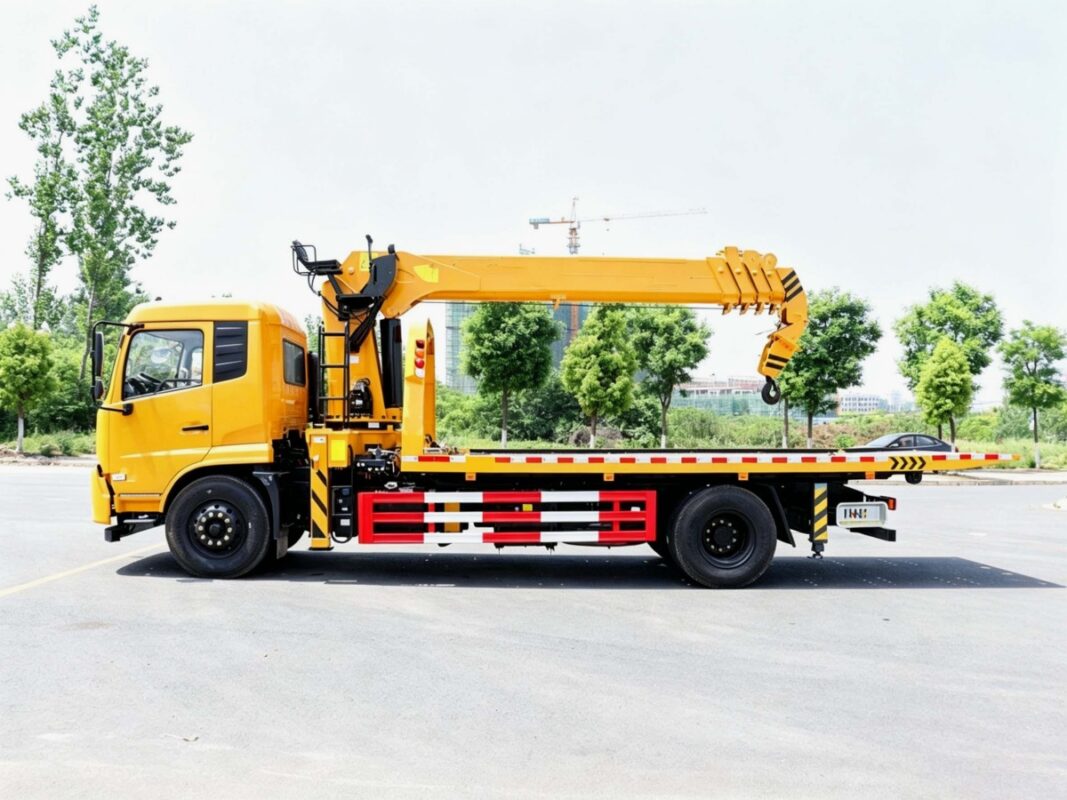
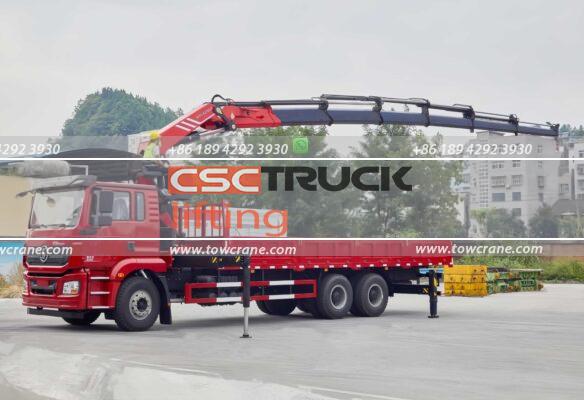
Modern towing and recovery is no longer just about brute lifting power. It is a balance of precision engineering, hydraulic control, and operational adaptability. At the center of this evolution are two dominant boom designs used on a flatbed wrecker: the straight boom crane and the knuckle boom crane.
Understanding the differences between them is essential for towing operators, fleet managers, and even vehicle recovery planners who must decide which system performs best under real-world constraints.
The Straight Boom: Strength Through Simplicity
The straight boom is the most traditional form of recovery lifting system. It operates on a telescopic linear-extension principle, using hydraulic force to extend outward directly.
Core Engineering Characteristics
A straight boom typically features:
A telescopic hydraulic cylinder system
A single-axis lifting motion
A rigid structural steel frame
High vertical lifting capacity
Operational Strengths
The straight boom excels in:
Direct vertical lifts
Heavy-load stability
Reduced mechanical complexity
Lower maintenance frequency
Because it has fewer joints and moving articulation points, it is mechanically efficient and highly durable under repetitive heavy-duty use.
Limitations in Real Operations
However, its rigidity creates operational constraints:
Requires near-perfect vehicle alignment
Limited ability to operate around obstacles
Inefficient in tight urban or obstructed environments
Higher dependency on truck positioning accuracy
In essence, the straight boom is powerful—but not flexible.
The Knuckle Boom: Engineering Flexibility in Motion
The knuckle boom introduces articulation through multiple hydraulic joints, allowing it to bend and reposition like a mechanical arm.
This design transforms towing from a linear lift into a multi-dimensional recovery operation.
Core Engineering Characteristics
A knuckle boom includes:
Multiple articulated hydraulic joints
Independent movement segments
360° operational flexibility (depending on mounting)
Advanced load balancing systems
Operational Strengths
The knuckle boom dominates in complex environments:
This makes it especially valuable in modern urban towing fleets.
The Articulation Advantage: Why Geometry Matters
The real difference between the two systems lies in kinematics and reach geometry.
A straight boom operates along a fixed linear axis. This means the load path is predictable but rigid.
A knuckle boom, however, can:
Change lift angle mid-operation
Adjust reach dynamically
Shift load positioning without moving the truck
Maintain stability while working off-axis
Practical Implications
This translates into major real-world advantages:
Faster clearance of accident scenes
Reduced need for traffic repositioning
Safer extraction from unstable terrain
Lower risk of secondary vehicle damage
In modern recovery scenarios, flexibility often outweighs raw lifting force.
Hydraulic Systems and Control Precision
Both systems rely on hydraulic power, but their control architecture differs significantly.
Straight Boom Hydraulics
Simpler circuit design
Fewer control valves
Direct cylinder extension
Easier diagnostics
Knuckle Boom Hydraulics
Multi-circuit hydraulic distribution
Independent joint control
Load-sensing systems
Higher precision control valves
This makes the knuckle boom more advanced—but also more complex to service.
Safety Considerations in Recovery Operations
Safety is one of the most critical differentiators between these two systems.
Straight Boom Safety Profile
Stable under vertical loads
Predictable load behavior
Requires precise truck positioning
Higher risk in angled lifts
Knuckle Boom Safety Profile
Better load control in unstable environments
Reduced the need for repositioning near traffic
Allows safer operator distance via remote systems
Minimizes sudden load swing in complex lifts
In accident recovery zones, these differences can significantly affect overall site risk.
Maintenance, Cost, and Lifecycle Considerations
The choice between systems is not only operational—it is also financial.
Straight Boom
Lower initial purchase cost
Easier maintenance routines
Fewer hydraulic failure points
Longer service intervals
Knuckle Boom
Higher upfront investment
More complex hydraulic maintenance
Requires specialized technician knowledge
Greater long-term operational versatility
Fleet operators often choose based on mission type rather than cost alone.
Real-World Application Scenarios
Different environments favor different boom systems:
Urban Towing
Dominated by knuckle boom systems
Tight streets and parked vehicles require articulation
Highway Recovery
Often uses straight boom systems
Straightforward vehicle positioning and heavy lifting
Underground Parking Garages
Strong preference for knuckle boom
Limited vertical clearance and tight maneuvering space
Heavy Commercial Recovery
Mixed usage depending on load geometry
The Future: Hybrid Recovery Systems
The industry is moving toward hybrid systems combining:
Straight boom lifting strength
Knuckle boom articulation
Digital load monitoring
Automated stabilization systems
This evolution reflects a broader shift: recovery is becoming a precision engineering discipline, not just a towing service.
Conclusion: Strength vs. Intelligence in Design
The debate between knuckle boom vs. straight boom is ultimately about operational philosophy.
The straight boom represents strength, simplicity, and reliability
The knuckle boom represents adaptability, intelligence, and precision
In modern recovery environments, where space is limited and risk is high, the articulation advantage of the knuckle boom increasingly defines industry standards.
Yet, in heavy-duty, straightforward lifting tasks, the straight boom remains a proven and indispensable tool.
The real future lies not in replacing one with the other—but in understanding when each design delivers its maximum advantage.