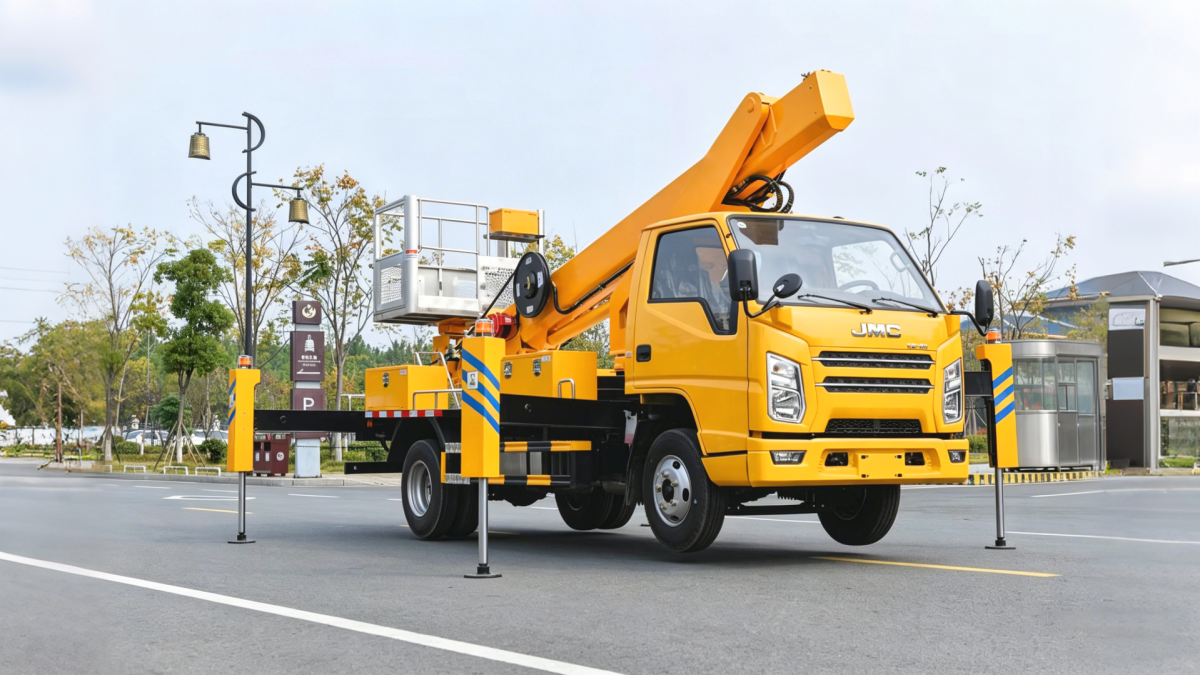
If you’ve ever seen a tall truck with a long, straight arm lifting a worker high up to fix power lines or trim trees, you’ve seen atelescopic aerial lift truck. These machines are essential for any job that requires reaching heights safely and efficiently. But what makes them work? In this beginner’s guide, we’ll break down the key components of a telescopic aerial lift truck in simple terms.
What Is a Telescopic Aerial Lift Truck?
A telescopic aerial lift truckis a vehicle-mounted lifting device. Its most obvious feature is a long, multi-section arm that slides out (telescopes) to reach high places. At the end of the arm is a bucket or platform where a worker stands. The truck can drive to a job site, stabilize itself, and lift the worker to the needed height. Unlike articulated (bending) arms, the telescopic arm stays straight, making it ideal for direct, vertical access.
Now let’s look at the main parts that make this possible.
1. The Truck Chassis
The chassis is the base of the whole machine — it’s the truck itself. It carries everything: the engine, the cab for driving, the wheels, and all the lifting components. The chassis is built to be strong and stable. It also includes the outriggers (which we’ll discuss next). In China, most telescopic aerial lifts use a standard truck chassis from brands like ISUZU, Tīrore, Dongfeng, SHACMAN and etc. The chassis must be heavy-duty enough to support the weight of the arm, the platform, and the worker without tipping over.
2. Outriggers (Stabilizers)
Before any lift happens, the truck must be absolutely steady. That’s where outriggers come in. Outriggers are hydraulic legs that extend from the sides of the chassis and press down onto the ground. They lift the truck’s wheels slightly off the ground or just take the weight to create a wide, stable base. Without outriggers, the truck could tip when the arm extends sideways. Most telescopic aerial lifts have four outriggers — two on each side. Some also have front or rear stabilizers for extra safety.
3. Turntable and Rotation System
The turntable is a large bearing that sits between the chassis and the upper part of the lift. It allows the entire lifting arm and platform to rotate left and right, often a full 360 nekehanga. This rotation is powered by a hydraulic motor. Thanks to the turntable, the operator can position the platform exactly where it’s needed without moving the truck. This is especially useful when working along power lines or building facades.
4. Telescopic Boom (The Arm)
The telescopic boom is the star of the machine. It’s made of several hollow steel sections that slide inside one another like a collapsible antenna. A hydraulic cylinder pushes the inner sections out to extend the arm, and pulls them back to retract it. The number of sections determines how high the arm can reach. More sections mean more height, but also more weight. The boom is designed to be strong yet lightweight, and it usually has a small amount of bend or flex to absorb movement.
5. Pūnaha Hydraulic
Almost every moving part on a telescopic aerial lift truck is powered by hydraulics — using pressurized oil to create force. The hydraulic system includes a pump (powered by the truck’s engine), a reservoir for oil, valves, hoses, and cylinders. When the operator moves a control lever, oil flows to a specific cylinder, causing it to extend or retract. This smooth, powerful system allows precise control of the boom, rotation, and outriggers. Because hydraulics can hold pressure, the platform stays in place even if the engine stops.
6. Work Platform (Bucket)
At the end of the boom is the work platform. This is a small bucket or flat area where the worker stands. It has guardrails to prevent falls and a gate for access. Some platforms are large enough for two people and tools. The platform is usually made of steel or aluminum and can tilt or rotate for better positioning. Many models also include an auxiliary control panel inside the platform so the worker can operate the boom themselves — up, down, rotate, and even drive the truck (on some models).
7. Controls and Control System
There are two sets of controls on a telescopic aerial lift. The first set is on the truck chassis, near the turntable. This is used by a ground operator to extend the outriggers and raise the boom before the worker climbs up. The second set is inside the work platform. These controls let the worker move the boom, rotate, and sometimes drive the truck slowly. Modern lifts use joysticks for intuitive control. Some also have a remote control for ground operation. The control system includes safety interlocks to prevent accidental movement.
8. Safety Devices
Safety is the most important part of any aerial lift. Key safety devices include:
Load limit sensor: Prevents the lift from operating if the platform is overloaded.
Angle limiter: Stops the boom from going too far or too low.
Emergency stop buttons(both on the ground and on the platform).
Manual descent valve: Allows the platform to be lowered if the hydraulic system fails.
Harness attachment points: For a safety harness to prevent falls.
Outrigger interlock: Prevents the boom from moving if the outriggers are not properly set.
9. Power Source
Mosttelescopic aerial liftsuse the truck’s own engine to power the hydraulic pump. Some models have a separate auxiliary engine or an electric motor for quieter, cleaner operation (especially useful indoors or in residential areas). The power source drives the pump that sends oil to all hydraulic cylinders and motors.
Putting It All Together
Now you know the nine key components of atelescopic aerial lift truck. The truck chassis and outriggers provide a stable base. The turntable allows rotation. The telescopic boom extends to reach a height. The hydraulic system powers every movement. The platform carries the worker safely. Controls let the operator direct everything, while safety devices protect against mistakes.
Understanding these parts helps you appreciate what these machines do — and why they are so reliable for high‑reaching work. Whether you are a new operator, a fleet manager, or just curious, knowing the basics will make you more confident around these impressive vehicles.
CSCTRUCK Towcraneoffers a full range of telescopic aerial lift trucks, customizable for utility, whakatūranga, and maintenance applications. Contact us to learn more about our fleet solutions.