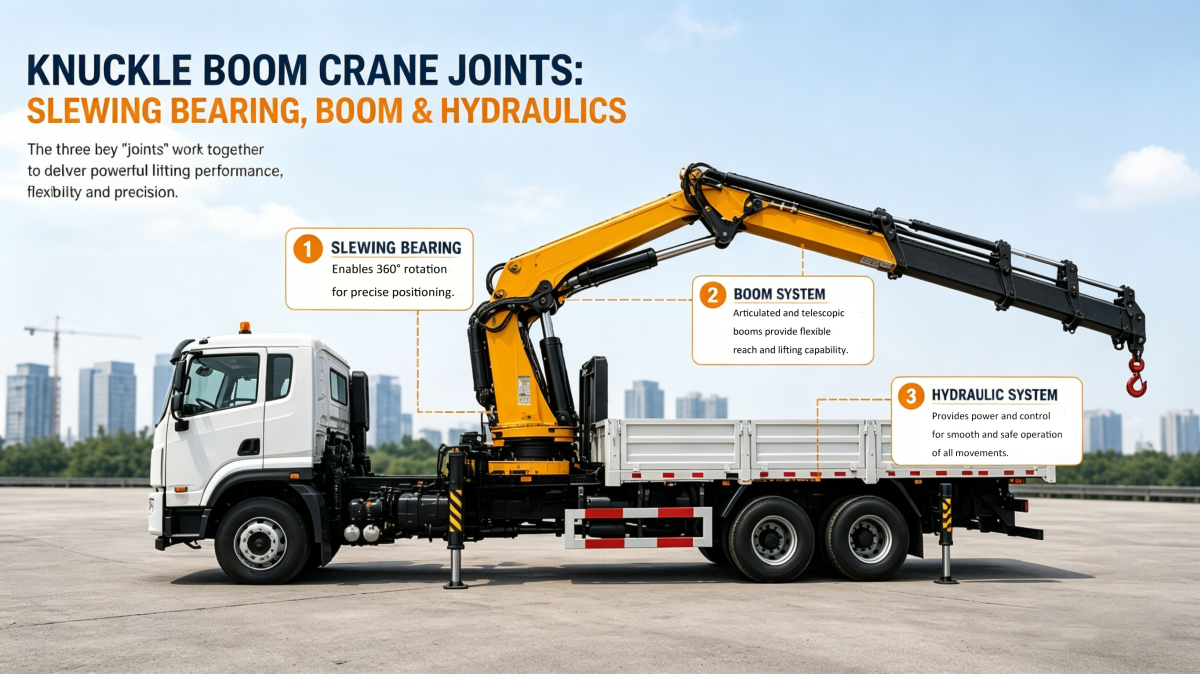
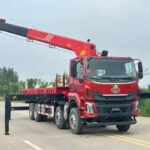
Knuckle boom cranesare known for theirflexibility, compact design, and precise lifting capability. What gives them this unique performance isn’t just the overall structure—but the way their “joints” work together. Much like a human arm, these cranes rely on coordinated movement between key components to lift, rotate, and position loads efficiently.
In this article, we break down the three core “joints” of a knuckle boom crane: theslewing bearing, theboom system, and thehydraulic system—and explain how they work together to power modern lifting operations.
What Are “Joints” in a Knuckle Boom Crane?
The term “joints” refers to themechanical connection points and movement systemsthat allow the crane to:
Rotate
Extend and retract
Lift and position loads
Unlike traditional straight boom cranes, knuckle boom cranes featurearticulated sections, giving them greater maneuverability—especially in tight or complex working environments.
Slewing Bearing: The Rotation Joint
Theslewing bearingis what allows the crane torotate horizontally, typically up to 360 degrees. It connects the crane’s upper structure to its base.
Key Functions:
Enables smooth and controlled rotation
Distributes load evenly during lifting
Supports both axial and radial forces
Why It Matters:
Without a reliable slewing bearing, the crane would not be able toposition loads accuratelyor operate efficiently in confined spaces. High-quality bearings also ensurelong-term durability and safetyunder heavy loads.
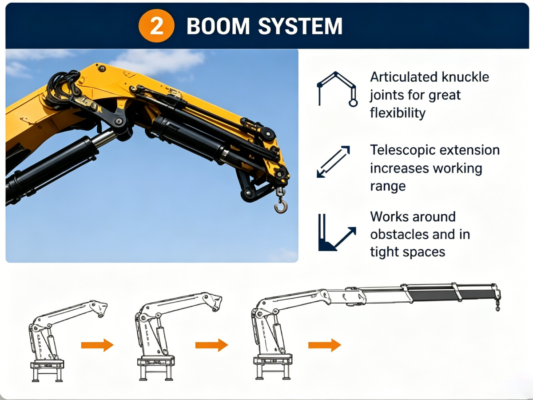
Boom System: The Reach and Flexibility
Theboom systemis the most visible and dynamic part of the crane. Inknuckle boom cranes, it usually consists of:
Articulated arms (knuckle joints)
Telescopic extensions (in some models)
Key Functions:
Extends reach horizontally and vertically
Folds compactly for transport
Provides precise load positioning
Advantages:
Greater flexibility compared to straight boom cranes
Ability to work around obstacles
Efficient operation inurban, construction, and logistics environments
The “knuckle” design allows the boom to bend like an arm, making it ideal forcomplex lifting scenarios.
Hydraulic System: The Power Behind Movement
Thehydraulic systemis the driving force that powers every movement of the crane—from lifting loads to extending the boom and rotating the structure.
Key Components:
Hydraulic cylinders
Pumps and valves
Hoses and fluid reservoirs
Key Functions:
Converts hydraulic pressure into mechanical motion
Controls lifting, extension, and articulation
Ensures smooth and precise operation
Why It’s Critical:
Hydraulics provide thestrength and controlneeded for safe lifting. A well-designed system ensures:
Stable load handling
Responsive operation
Reduced operator fatigue
How These “Joints” Work Together
The real strength of aknuckle boom cranelies in thecoordinationbetween these three systems:
Theslewing bearingrotates the crane into position
Theboom systemreaches and adjusts to the load
Thehydraulic systempowers and controls every movement
This integrated operation allows for:
High precision lifting
Efficient workflow
Improved safety in tight spaces
Applications Across Industries
Thanks to their jointed design, knuckle boom cranesare widely used in:
Construction projects
Logistics and material handling
Utility and maintenance operations
Marine and port environments
Their ability to operate inrestricted spacesmakes them especially valuable in urban and industrial settings.
Conclusion
Understanding the “joints” of aknuckle boom crane—theslewing bearing, boom system, andhydraulic system—helps explain why these machines are so versatile and efficient.
Each component plays a critical role, but it’s theircombined performancethat delivers the flexibility, power, and precision modern operations demand.
Looking to Enhance Your Lifting Capabilities?
If your operations requireefficient material handling, flexible lifting solutions, orreliable crane performance, a knuckle boom crane could be the ideal choice.
CSCTRUCK Towcraneoffers a range ofloader craneswith advanced hydraulic systems and customizable configurations to suit differentload capacities, working environments, andindustry needs. The right equipment can make all the difference in improving productivity and safety on site.