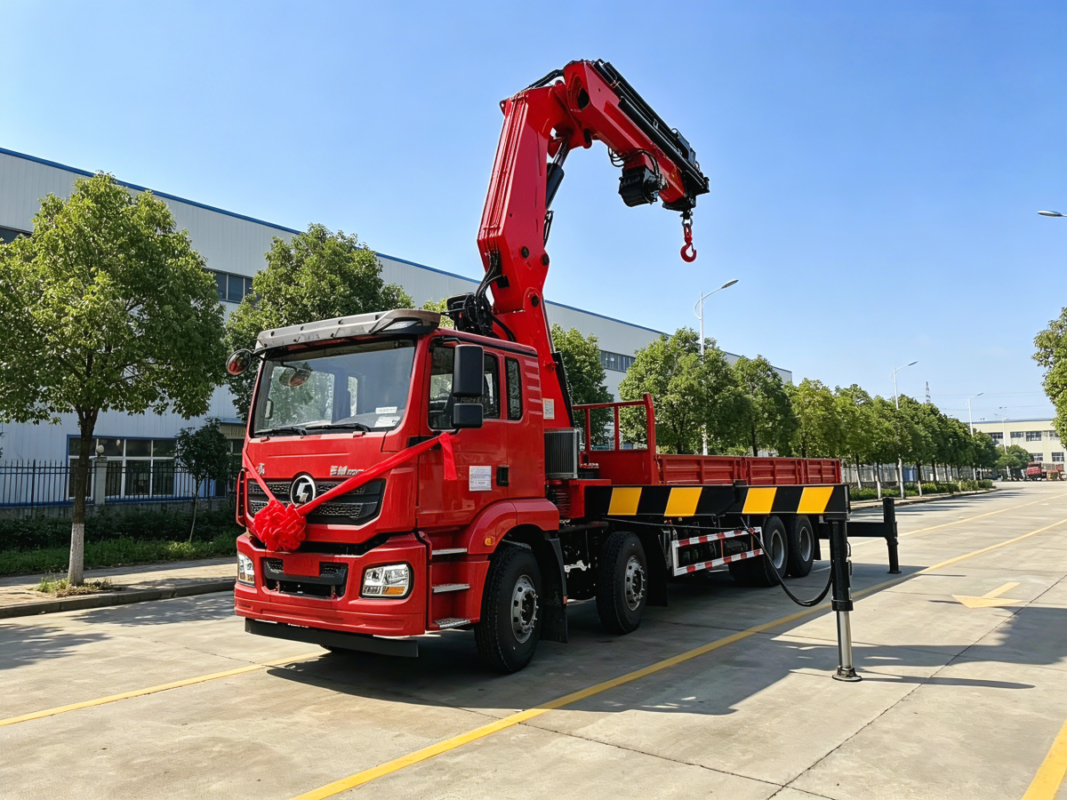
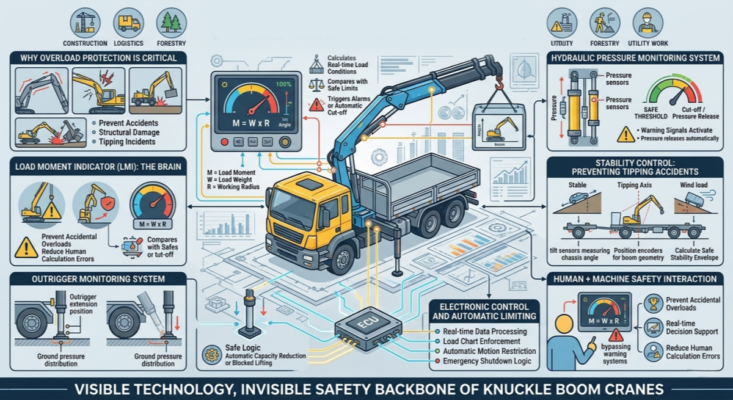
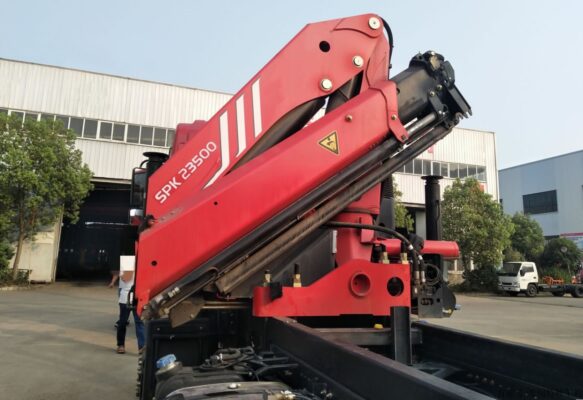
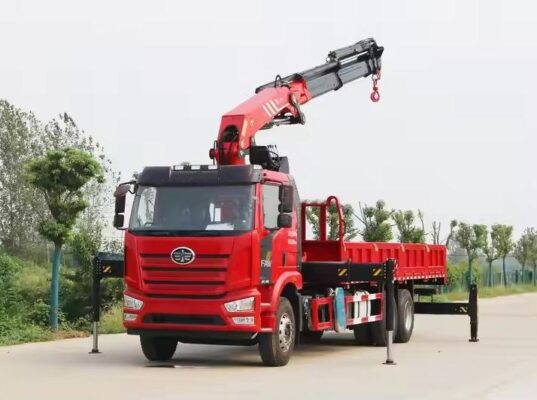
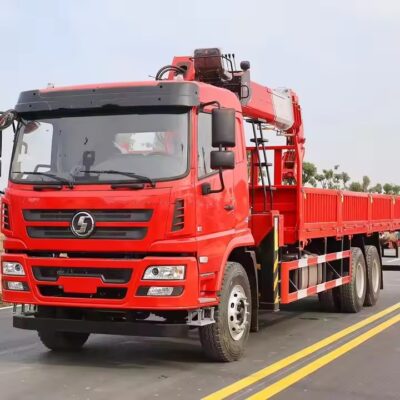
Knuckle boom cranes are widely used in construction, logistics, forestry, and utility work because of their flexibility and compact design. But behind their impressive lifting capability lies a critical engineering challenge: keeping the crane stable and preventing overload failures.
Modern knuckle boom cranes rely on advanced safety systems that constantly monitor load conditions and machine stability. These systems are not optional—they are essential for preventing accidents, structural damage, and tipping incidents.
1. Why Overload Protection Is Critical
Every crane has a defined maximum rated load, but real working conditions are rarely ideal. Factors such as boom angle, extension length, wind force, and ground slope can all reduce safe lifting capacity.
Without protection systems, operators might unknowingly exceed safe limits, leading to:
Structural deformation of the boom
Hydraulic system failure
Loss of stability and tipping accidents
Catastrophic equipment damage or injury
Overload protection systems are designed to prevent these scenarios before they happen.
2. Load Moment Indicator (LMI): The Brain of Safety Control
At the core of modern safety systems is the Load Moment Indicator (LMI), sometimes called the Load Moment System (LMS).
How it works
The LMI continuously calculates the load moment, which is the product of:
Load weight
Working radius (distance from crane base)
M = W \times R
Where:
M = load moment
W = lifted weight
R = working radius
What it does
Monitors real-time load conditions
Compares them with safe working limits
Triggers alarms or automatic cut-off when limits are exceeded
Operator feedback
Most systems provide:
Visual displays (load percentage, boom angle)
Audible alarms
Automatic motion restriction (e.g., blocking further extension)
3. Hydraulic Pressure Monitoring System
Hydraulic pressure is directly related to lifting force. Therefore, monitoring pressure is a key part of overload protection.
Function
Sensors track hydraulic pressure in lifting cylinders and compare it with safe thresholds.
Safety response
When abnormal pressure is detected:
Warning signals are activated
Certain movements may slow down or stop
System may automatically release pressure to avoid damage
This prevents internal stress from exceeding design limits of cylinders and hoses.
Even if a crane is not overloaded, it can still tip due to poor stability conditions. This is why modern systems include stability control mechanisms.
Key factors affecting stability
Outrigger extension position
Ground firmness and slope
Boom direction and angle
Wind load and dynamic movement
Stability sensors
Advanced cranes use:
Tilt sensors (measuring chassis angle)
Outrigger pressure sensors
Position encoders for boom geometry
These inputs help the system calculate whether the crane is operating within a safe stability envelope.
5. Outrigger Monitoring System
Outriggers are critical for stabilizing knuckle boom cranes during operation.
What the system checks
Whether outriggers are fully extended
Ground pressure distribution
Uneven settlement or sinking
Safety logic
If outriggers are not properly deployed:
Crane lifting capacity is automatically reduced
In some systems, lifting is completely blocked
This ensures the crane cannot operate in unsafe configurations.
6. Electronic Control and Automatic Limiting
Modern knuckle boom cranes are increasingly integrated with electronic control units (ECUs).
Functions include:
Real-time data processing
Automatic motion restriction
Load chart enforcement
Emergency shutdown logic
This shift from mechanical to digital control has significantly improved operational safety and precision.
7. Human + Machine Safety Interaction
Even with advanced automation, operator behavior remains critical.
Safety systems are designed not to replace operators, but to:
Prevent accidental overloads
Provide real-time decision support
Reduce human calculation errors
However, bypassing or ignoring warning systems remains one of the leading causes of crane accidents.
Conclusion
Overload protection and stability control systems are the invisible safety backbone of knuckle boom cranes. Through technologies like load moment indicators, hydraulic pressure monitoring, outrigger sensors, and electronic control systems, modern loader cranes are able to operate safely even under complex and demanding conditions.
Understanding these systems is not only important for engineers and operators—it is essential for anyone responsible for equipment selection, site safety, or lifting operations.