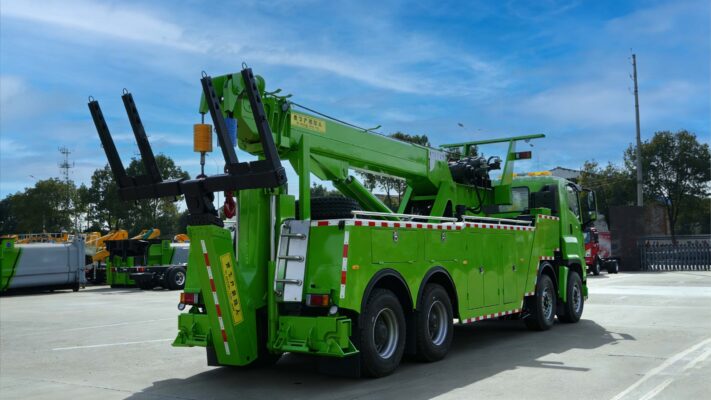
On a highway, you might have seen a massive tow truck whose boom doesn’t just lift from the front or back — it swivels around like a giant mechanical arm, reaching into ditches, over barriers, and under overturned trucks. That’s aэвакуатор ротатора. Unlike ordinary wreckers, a rotator can work a full360 степени.
But how does a machine that weighs over 20 tons manage to spin its boom in a complete circle without twisting its own hoses into knots? And how does it lift a loaded semi‑trailer from the side without tipping over? Let’s break down the engineering in plain language.
Why 360° rotation matters
First, imagine this: a fully loaded tractor‑trailer has rolled onto its side in a deep ditch beside a narrow highway. The truck’s nose points one way, its tail another. A conventional wrecker can only pull straight from the front or rear — neither angle works well. The recovery zone is tight: a guardrail on one side, a steep slope on the other.
A rotator solves the problem by letting the operatorswing the boom to exactly the right angle— from the side, diagonally, or even from behind an obstacle. That flexibility means faster, safer recoveries with less equipment. It’s not just a luxury; for heavy‑duty rescue, it’s a game‑changer.
The secret: a giant rotating “turntable”
At the heart of every rotator tow truck is aslew ring (a huge bearing with gear teeth) and ahydraulic slew drive.
1. The slew ring – like a lazy Susan on steroids
Between the truck’s fixed chassis and the rotating upper structure (бум, cab, лебедки) sits a massive bearing. Its outer race is bolted to the chassis; the inner race, which has gear teeth around its inside edge, supports everything that rotates. Think of a dinner‑table lazy Susan — but this one handles dozens of tons and must turn smoothly under extreme loads.
2. The slew drive – hydraulic muscle
A hydraulic motor turns a small pinion gear that meshes with the teeth of the slew ring. When the operator moves the control, high‑pressure oil flows into the motor, and the pinion walks around the slew ring, rotating the entire upper structure. Change the oil flow direction, and the boom rotates the other way. By precisely adjusting oil flow and pressure, the operator can creep the boom at a fraction of a degree per second or spin it faster (typically 0.1 к 1.5 об/мин). For heavy lifts, slow and steady wins the race.
The “unwinnable” problem: how to keep hoses from twisting
If the boom can spin endlessly, what stops the hydraulic hoses and electrical cables from tangling and snapping? The answer is a clever device called acenter rotary joint (also known as a rotary union or swivel).
This precision component sits right at the rotation center. It has multiple sealed channels — some for high‑pressure hydraulic oil, others for low‑voltage electrical signals. The outer housing rotates with the boom, while the inner shaft stays fixed to the chassis. No matter how many times the boom turns, oil and electricity flow freely through the joint without a single hose winding up. It’s like arotating tunnelfor power and control.
Reaching out and lifting heavy: бум & winch
Rotating is only half the story. A rotator must alsoreach far и lift huge weights.
Telescopic boom – multiple sliding sections
The boom is built from three to six nested steel boxes, much like a telescope. Hydraulic cylinders (or cable extension systems) push each section outward. In seconds, the boom can grow from 5 meters to 13 meters or more. That reach allows operators to grab a wreck that has tumbled down an embankment or across a median barrier.
Winches – the real muscle
At the boom tip, you won’t find a simple hook — instead, there are hydraulic winches. A winch contains a drum wound with high‑strength steel cable and a powerful brake. Hydraulic oil spins the drum, paying out or hauling in the cable.
Advanced rotators often havetwo or even four winches. Например, a heavy‑duty model may carry two 15‑ton winches. Used separately, they provide two independent pulls. Used together (synchronized), they deliver 30 tons of combined force — enough to upright a rolled‑over semi or lift it from a ravine. Multi‑winch setups also allow controlled, balanced lifting from multiple attachment points.
How does it not tip over? – Outriggers save the day
Lifting a heavy load from the side creates a huge tipping force. A conventional wrecker would simply fall over. A rotator prevents this withwide‑span hydraulic outriggers.
These legs extend sideways (and sometimes forward/backward) from the chassis, then press down on the ground with large, pivoting pads. When fully deployed, the truck’s support width can increase from about 2.5 meters to over 5 meters — a massive stability boost.
Кроме того, the truck’s computer constantly monitors aload moment indicator (LMI). It calculates the boom angle, extension length, and actual load weight. If the operator tries a lift that would exceed safe limits, the system sounds an alarm and automatically cuts power to dangerous functions. Think of it as an electronic fuse that prevents the driver from accidentally tipping the truck.
A typical 360° rescue in action
Let’s walk through a real‑world recovery to see how all these systems work together:
1. Arrival– The rotator parks near the overturned truck, but not necessarily straight in line.
2. Stabilize– The operator pushes a button; four outriggers extend and plant themselves firmly on the ground.
3. Rotate to target– Using the slew drive, the operator swings the boom 120° to align with the overturned truck’s frame rails.
4. Extend the boom– Two sections of the telescopic boom slide out so the hook is directly above the lift point.
5. Lower cables– The winch pays out cable; riggers attach slings or hooks to the wreck.
6. Lift and rotate– The boom slowly lifts the wreck while the operator may also use a second winch to pull sideways, gradually righting the overturned vehicle.
7. Recover– Once upright, the rotator can either lift the truck onto a carrier or tow it away on its own wheels. The entire sequence is controlled by one operator from the cab using a few joysticks.
Краткое содержание: engineering that looks like magic
A rotator tow truck’s 360° boom is not magic — it’s the result of several technologies working in harmony:
Slew ring + hydraulic motor→ unlimited rotation with precise control
Center rotary joint→ no tangled hoses, no broken wires
Telescopic boom + powerful winches→ long reach and massive lift capacity
Wide outriggers + load moment indicator→ safe side‑lifting without tipping
The next time you see one of these orange or yellow giants working on a highway, take a moment to appreciate the engineering inside. That seemingly effortless spin and lift is backed by decades of hydraulic innovation and safety design.
CSCTRUCK towcraneoffers a wide range of high-qualitytow trucks, including rotator wreckers, customized to meet various recovery and heavy-duty towing needs.