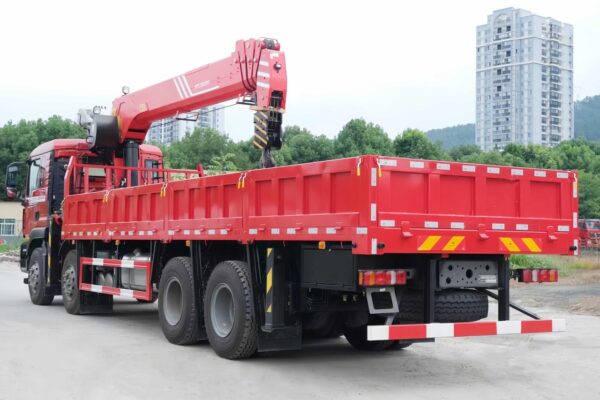
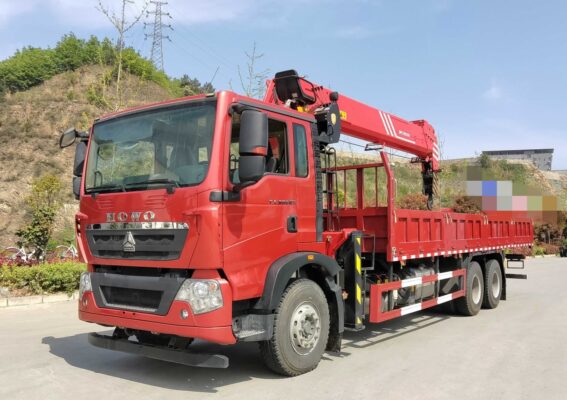
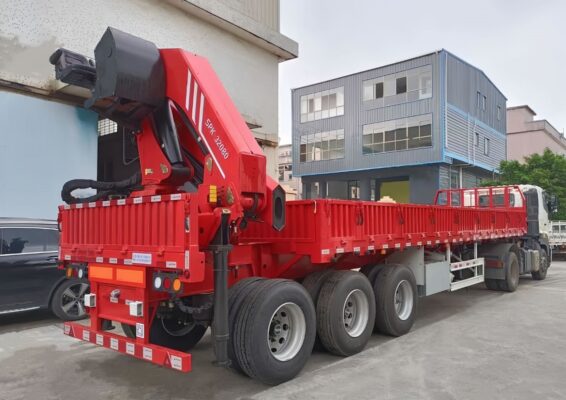
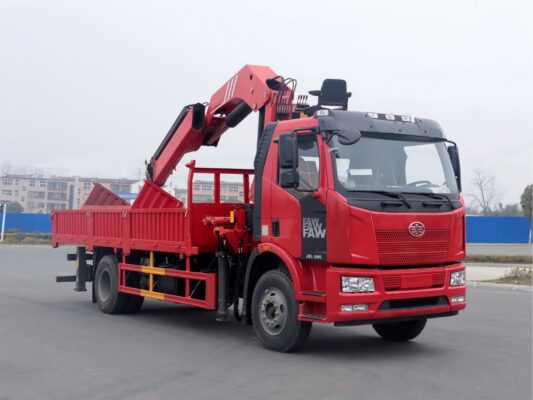
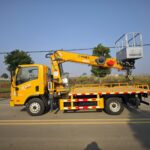
In our daily lives, au ʻa e lolis play an important role in various fields such as construction, logistics, and transportation. Neongo ia, despite their ubiquity, many people still lack a comprehensive understanding of these powerful machines. ʻI he fakamatala ko ʻeni, we will delve deep into the common knowledge ofau ʻa e lolis to help you gain a better understanding of their structure, function, and characteristics.
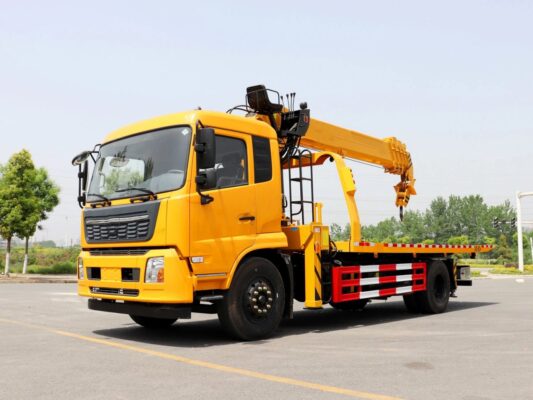
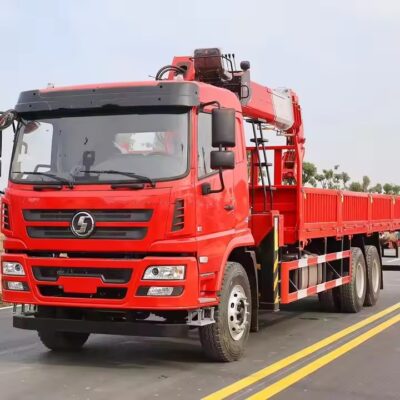
Ko e au ʻa e loli, also known as a truck-mounted lifting transporter, is a remarkable piece of equipment that combines the mobility of a truck with the lifting capabilities of a crane. Through a sophisticated hydraulic lifting and telescoping system, it is able to perform the tasks of lifting, slewing, and hoisting goods with precision and efficiency. Typically assembled on a truck chassis, au ʻa e lolis offer a flexible and convenient solution for a wide range of applications.
Let’s begin by exploring the forms of the boom of theau ʻa e loli. The boom is a crucial component of the au ʻa e loli, as it directly determines the lifting height and reach of the machine. There are two main forms of booms: straight boom and folding boom.
The straight boom au ʻa e lolioperates by extending or retracting the boom through the telescopic cylinder of the boom. This mechanism allows for a variable lifting height, enabling the crane to reach different levels. In addition, the straight boomau ʻa e lolilifts the goods by wire rope through the winch mechanism. This setup provides a stable and reliable lifting method, ʻai ke feʻunga ia ki ha ngaahi polokalama kehekehe. The straight boomau ʻa e lolihas several advantages. It has a wider range of use, as it can handle various types of loads and work in different environments. ʻIkai ngata ai, it is more stable and safer due to its rigid structure and reliable lifting mechanism.
On the other hand, the folding boom au ʻa e lolioperates in a different manner. It mainly lifts the goods directly through the change of the oil cylinder. This design allows for a faster action and higher work efficiency. The folding boom can be quickly extended and retracted, enabling the crane to complete tasks in a shorter time. The folding boom au ʻa e loliis particularly suitable for applications where speed and efficiency are crucial, such as in emergency response situations or when time is of the essence.
Next, let’s understand the slewing mode of theau ʻa e loli. The slewing mode determines how the crane can rotate and position the load. There are two structural forms of slewing modes: rack slewing and slewing bearing.
Rack slewing is a mechanism where the oil cylinder drives the rack to move and make the column rotate. Neongo ia, this method has its limitations. Since the rack is a straight line, it cannot move forward anymore when it rotates to a certain position. As a result, rack slewing has a limited range of rotation. This can be a disadvantage in some applications where a wider range of rotation is required.
In contrast, slewing bearing rotation offers a more versatile solution. In this mode, the gear of the slewing box drives the full rotation of the gear of the slewing bearing. This allows for an arbitrary rotation without direction, which we generally call 360-degree rotation. This slewing mode is more practical as it provides greater flexibility in positioning the load. The crane can rotate freely in any direction, enabling it to access hard-to-reach areas and perform tasks with ease.
Now, let’s talk about the outriggers of theau ʻa e loli. Outriggers are an essential part of the au ʻa e lolias they provide stability and support during lifting operations. There are two types of outriggers: fixed outriggers and movable outriggers.
The fixed outriggers are directly extended downward by the oil cylinder. These outriggers have a relatively short span and are suitable for applications where space is limited or where a smaller footprint is required. Neongo ia, they may not provide as much stability as movable outriggers.
Movable outriggers, ʻi he tafaʻaki ʻe, offer greater stability and flexibility. They can be extended horizontally first and then extended downward. This design allows for a larger span, providing more stable support for the crane. Movable outriggers are particularly useful in applications where the ground is uneven or where the load is heavy. They can be adjusted to ensure that the crane remains stable and safe during lifting operations.
Finally, let’s take a look at the chassis of theau ʻa e loli. The chassis is the foundation of the au ʻa e loliand plays a crucial role in ensuring its performance and reliability. The chassis of theau ʻa e loliis a special chassis that is designed to handle the heavy loads and stresses imposed by the crane. It is built to have sufficient bearing capacity to support the weight of the crane and the load being lifted.
There are many brands ofau ʻa e lolichassis available in the market. Some of the ones with relatively good sales are Dayun Fengchi, Dayun Aopuli, Dongfeng Duolika, FAW Jiefang, Shaanxi Automobile, Sinotruk, and others. Each brand has its own unique features and advantages. Hange ko ʻeni, Dayun Fengchi and Dayun Aopuli are known for their durability and reliability. Dongfeng Duolika offers advanced technology and performance. FAW Jiefang is renowned for its quality and stability. Shaanxi Automobile and Sinotruk are also popular choices for their powerful engines and robust construction.
When choosing a au ʻa e lolichassis, several factors need to be considered. These include the load capacity required, the type of terrain and working conditions, and the specific needs of the application. It is important to select a chassis that is suitable for the intended use to ensure optimal performance and safety.
Fakaʻosí, au ʻa e lolis are complex machines with a variety of components and features. Understanding the forms of the boom, slewing mode, outriggers, and chassis is essential for anyone working with or considering usingau ʻa e lolis. By having a comprehensive knowledge of these aspects, you can make informed decisions and ensure the safe and efficient operation of these powerful machines. Whether it’s for construction, logistics, or any other application, au ʻa e lolis are an invaluable tool that can greatly enhance productivity and performance.