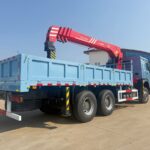
Across fast-growing infrastructure corridors in Vietnam, highway expansion projects are reshaping regional connectivity and logistics efficiency. One of the most critical operations in these projects is bridge girder installation, where massive precast concrete beams are lifted and positioned with precision. Among the most effective machines used for this task is the telescopic truck crane, valued for its mobility, reach, and adaptability in complex construction environments.
This blog explores how telescopic truck cranes are deployed in Vietnam’s highway bridge construction, highlighting their role in efficiency, safety, and engineering precision.
The Role of Telescopic Truck Cranes in Infrastructure Projects
A telescopic truck crane is a type of mobile crane mounted on a truck chassis, equipped with a boom that extends and retracts using hydraulic sections. This design allows it to quickly travel between sites and adapt to varying lifting heights without complex assembly.
In highway bridge projects, these cranes are essential for handling precast concrete girders, which often weigh dozens of tons. Their key advantages include:
High mobility between bridge spans and construction zones
Fast setup time compared to crawler cranes
Adjustable boom length for varying bridge heights
Strong lifting capacity suitable for heavy structural components
In Vietnam’s rapidly developing expressway system, where multiple bridge segments may be under construction simultaneously, this flexibility significantly improves project timelines.
Bridge Girder Installation Process
Installing a bridge girder is a highly coordinated engineering operation. The process typically includes several stages:
1. Preparation and Positioning
Before lifting begins, engineers inspect the bridge piers and ensure alignment accuracy. The telescopic truck crane is then positioned on stable ground, with outriggers deployed to distribute weight evenly.
2. Lifting the Girder
The crane’s hydraulic boom is extended to reach the girder, which is usually transported by a heavy-duty trailer. Rigging teams attach slings and shackles to secure the load, ensuring balance during the lift.
3. Controlled Rotation and Placement
Once lifted, the girder is carefully rotated and aligned with the bridge bearings. Precision is critical, as even minor misalignment can affect the structural integrity of the entire span.
4. Final Adjustment
Workers guide the girder into its final position using tag lines, followed by verification of alignment and secure seating on the supports.
Engineering Challenges in Vietnam’s Highway Projects
While telescopic truck cranes provide efficiency, highway bridge construction in Vietnam presents unique challenges:
Tropical weather conditions, including heavy rain and high humidity
Soft or uneven terrain, requiring careful crane stabilization
Urban traffic constraints in densely populated expansion zones
Strict safety coordination among multiple construction teams
To overcome these issues, engineers rely on real-time monitoring systems, advanced lifting simulations, and strict safety protocols. Crane operators must also be highly skilled, as precision lifting leaves little room for error.
Safety and Efficiency Improvements
Modern telescopic truck cranes are equipped with advanced safety features such as load moment indicators, anti-overload systems, and hydraulic stabilization controls. These technologies help ensure safe lifting even under challenging conditions.
In Vietnam’s highway expansion projects, these improvements translate into:
Reduced installation time per bridge span
Lower risk of structural damage during lifting
Improved coordination between logistics and on-site assembly
Enhanced overall project reliability
As infrastructure demand continues to grow, these cranes remain central to maintaining both speed and safety.
Conclusion
The use of telescopic truck cranes in bridge girder installation represents a critical intersection of mobility, power, and precision engineering. In Vietnam, where highway expansion is accelerating national development, these machines play an indispensable role in building durable, efficient transportation networks.
From lifting massive girders to enabling rapid bridge assembly, telescopic truck cranes are not just tools—they are key enablers of modern infrastructure transformation.