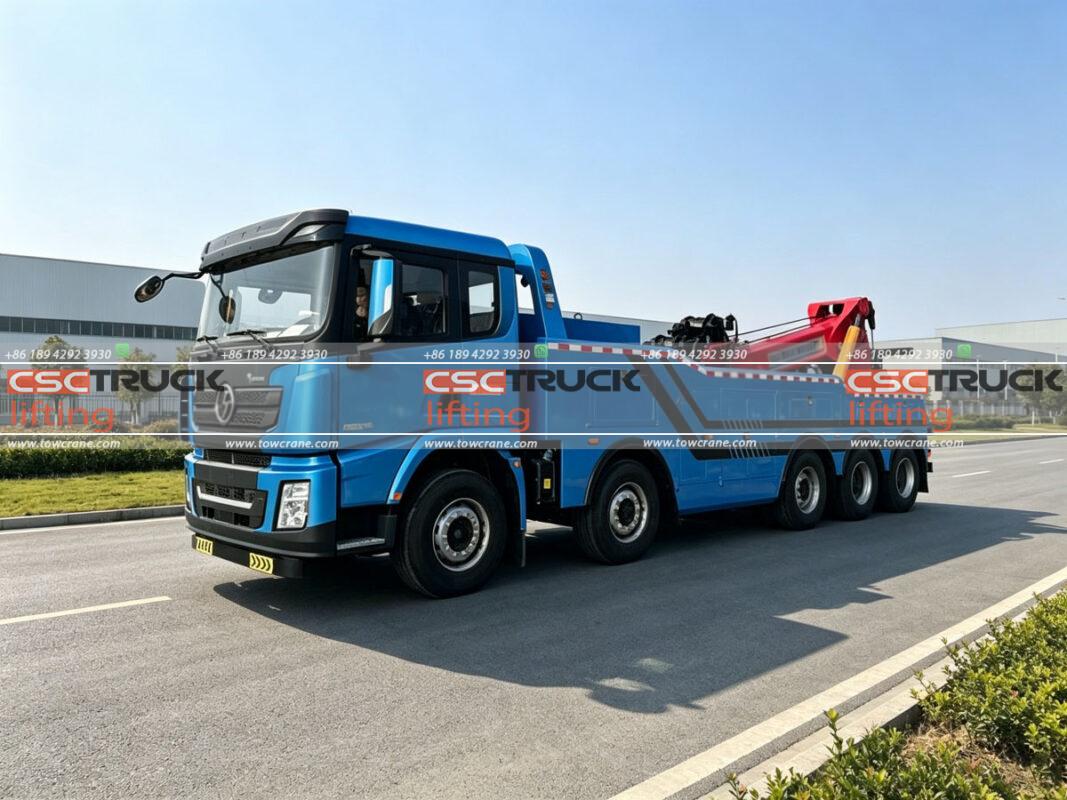
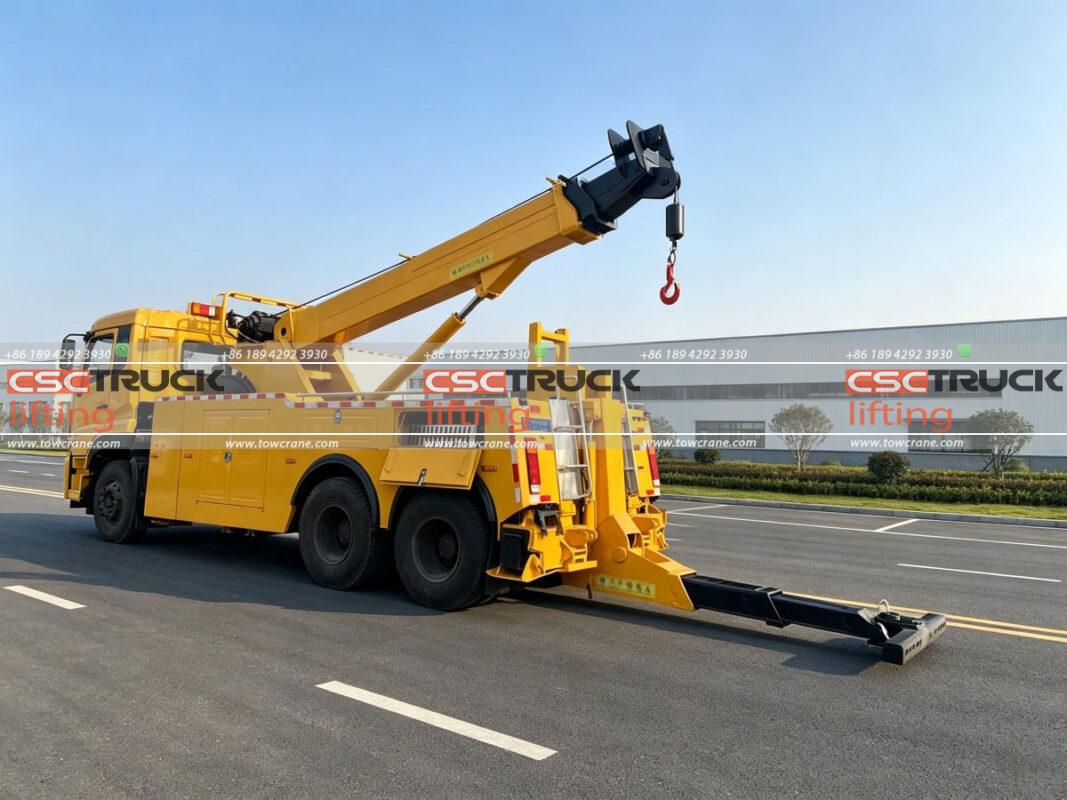
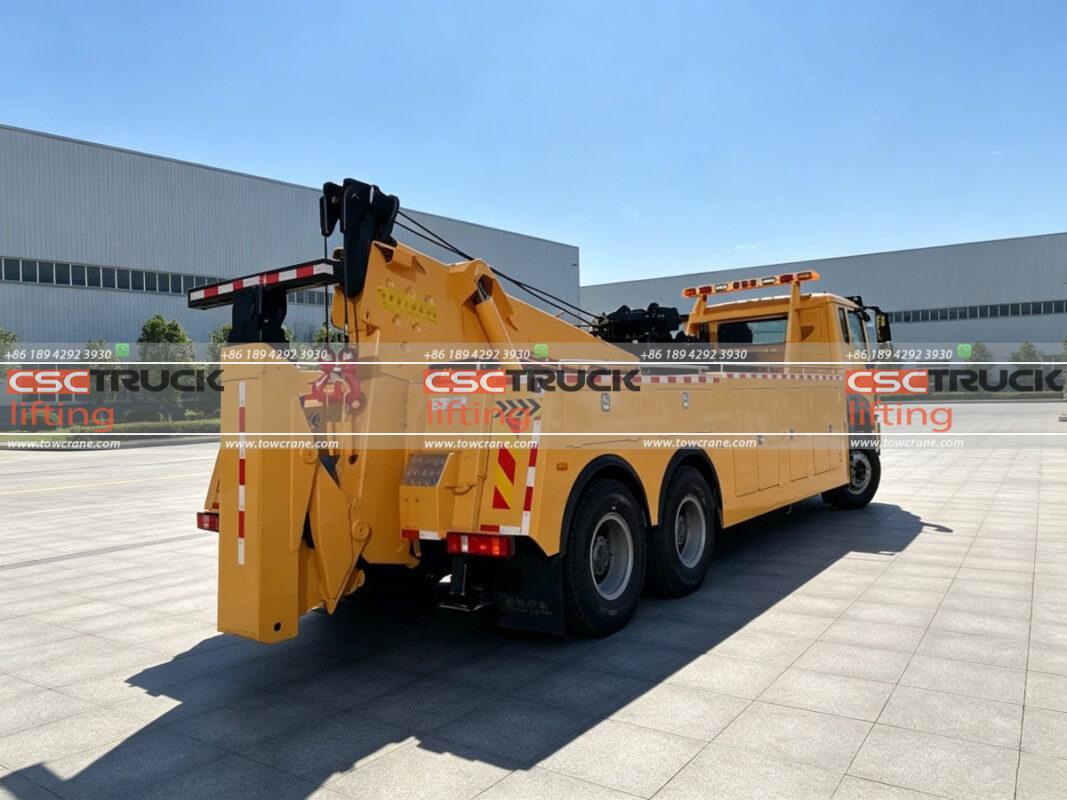
An integrated wrecker is designed to recover disabled, damaged, or improperly parked vehicles efficiently. Unlike a conventional tow truck, an integrated wrecker combines the towing boom, wheel-lift system, and recovery equipment into one purpose-built unit. However, the towing capacity of an integrated wrecker is not determined by a single specification. The chassis, boom, winch, wheel lift, hydraulic system, and actual towing conditions all influence how much weight the truck can safely recover.
Understanding these factors is important when selecting a wrecker for a recovery fleet. A truck with a high-rated winch, for example, does not necessarily have the same towing capacity as the complete vehicle.
1. Chassis and Gross Vehicle Weight
The chassis is the foundation of an integrated wrecker and has a direct impact on its overall towing capability. A heavy-duty chassis provides greater structural strength and allows the vehicle to carry a larger recovery body and heavier loads.
The gross vehicle weight rating (GVWR) and axle capacities must be considered together with the weight of the wrecker body and recovery equipment. If the chassis is overloaded, steering, braking, suspension, and stability can all be affected.
A suitable chassis should therefore provide enough capacity for:
The integrated wrecker superstructure
Winches and recovery equipment
Operators and tools
The recovered vehicle
Additional towing forces generated during operation
For heavy-duty recovery, selecting the appropriate chassis is one of the first steps in determining the practical towing capacity of the entire wrecker.
2. Engine Power and Transmission
Engine performance also affects towing capability, particularly when recovering heavy vehicles on slopes or uneven roads.
A powerful engine provides the torque required to move a heavy combination from a stationary position and maintain speed under demanding conditions. The transmission must also be capable of transferring this power efficiently to the drive wheels.
However, more horsepower does not automatically mean a higher towing capacity. The engine, transmission, axle ratio, driveline, and chassis must be properly matched. A balanced powertrain helps the integrated wrecker maintain reliable performance without excessive stress on its mechanical components.
3. Recovery Boom Design
The recovery boom is another important factor. Its structural strength, length, extension system, and working angle all affect how effectively the wrecker can recover a vehicle.
A stronger boom can handle greater recovery loads, but the actual capacity can change depending on the boom position. As the working distance increases, the load creates a larger moment on the boom and chassis.
For this reason, manufacturers generally provide different capacity ratings according to the working configuration. Operators should always follow the manufacturer’s load chart rather than assuming that the maximum rated capacity applies at every boom position.
4. Winch Capacity
The recovery winch provides the pulling force needed to bring a disabled vehicle onto a safe position or move it during recovery.
Winch capacity depends on factors such as:
Rated line pull
Number of winches
Cable size and length
Drum design
Hydraulic or mechanical drive
Number of cable layers on the drum
An integrated wrecker equipped with dual winches can provide greater flexibility for demanding recovery operations. However, the winch rating should not be confused with the towing capacity of the complete truck.
For example, a winch may have a high pulling rating, but the chassis, boom, wheel lift, or recovery points may impose a lower practical limit.
5. Wheel-Lift Capacity
The wheel-lift system is particularly important when the recovered vehicle is towed with two wheels raised from the ground.
Its capacity determines how much weight can be safely supported at the rear of the wrecker. The position of the lifted vehicle also matters. A heavier load placed farther from the wrecker’s rear axle generates greater leverage and can increase axle loading.
Therefore, operators need to consider both the wheel-lift capacity and the distance between the recovered vehicle and the wrecker. A vehicle may be within the nominal towing capacity but still create excessive axle or frame loads if it is positioned incorrectly.
6. Hydraulic System Performance
The hydraulic system powers many of the major recovery functions, including boom movement, telescoping, wheel-lift operation, and winching on hydraulically driven systems.
Hydraulic pressure and oil flow determine how effectively the equipment performs under load. An appropriately sized hydraulic system can provide smooth boom movement and consistent recovery performance.
Insufficient hydraulic capacity can lead to slow operation, reduced lifting or pulling performance, and excessive heat generation. Regular maintenance of hydraulic oil, hoses, valves, and other components is therefore essential for maintaining the wrecker’s designed performance.
7. Axle Load and Weight Distribution
Towing capacity is also closely related to axle load distribution. When a heavy vehicle is connected to the integrated wrecker, part of its weight is transferred to the wrecker’s axles.
If the load is distributed improperly, the rear axle or front axle may become overloaded even when the total vehicle weight appears acceptable.
The recovered vehicle should be positioned according to the manufacturer’s recommendations. Proper weight distribution helps maintain:
Steering control
Braking performance
Vehicle stability
Tire load capacity
Suspension performance
This is especially important for heavy-duty integrated wreckers recovering buses, trucks, construction vehicles, or other large vehicles.
8. Type and Condition of the Recovered Vehicle
The actual vehicle being recovered also has a major influence on towing requirements. A lightweight passenger car and a heavily loaded commercial truck place very different demands on a wrecker.
The operator should consider the recovered vehicle’s:
Curb or gross weight
Wheel configuration
Drive system
Overall dimensions
Tire condition
Steering condition
Brake condition
A vehicle with locked wheels or severe mechanical damage can require significantly more pulling force than a normally rolling vehicle of the same weight.
9. Road and Recovery Conditions
The stated towing capacity is normally based on specific operating conditions. Real-world recovery conditions can make the task considerably more demanding.
A vehicle being recovered on a flat, paved road generally requires less pulling force than one stuck on a steep slope, muddy construction site, soft shoulder, or uneven terrain.
Factors such as road gradient, surface friction, vehicle rolling resistance, weather, and recovery angle can all affect the force required.
This is why towing capacity should not be viewed as a simple maximum weight that applies to every recovery situation.
10. Recovery Configuration and Operating Technique
How the integrated wrecker is configured also matters. Boom extension, towing angle, wheel-lift position, cable routing, and the location of the recovered vehicle can all influence the forces acting on the recovery system.
Experienced operators use the correct recovery points, maintain appropriate angles, and avoid sudden shock loading. Smooth winching and controlled vehicle movement reduce unnecessary stress on the boom, winch, chassis, and recovery accessories.
Operators should always follow the manufacturer’s operating instructions and load charts when performing heavy recovery work.
How to Choose an Integrated Wrecker with the Right Towing Capacity
When selecting an integrated wrecker, buyers should look beyond the advertised towing capacity. The complete recovery system needs to be evaluated, including the chassis, engine, transmission, boom, winch, wheel lift, hydraulic system, and axle ratings.
For light-duty roadside recovery, a compact integrated wrecker may be sufficient. For commercial trucks, buses, and industrial vehicles, a heavier chassis with a stronger boom, higher-capacity winches, and greater axle capacity will be more appropriate.
The key is to match the wrecker’s rated capacity with the types and weights of vehicles your fleet actually needs to recover. Proper matching not only improves recovery efficiency but also helps protect the equipment and maintain safe operation.
For fleet operators looking for a reliable recovery solution, CSCTRUCK Towcrane offers integrated wrecker configurations designed for different vehicle recovery requirements, from general roadside assistance to heavy-duty recovery operations.