A wrecker tow truck boom is one of the most important components of a heavy-duty recovery vehicle. It allows the truck to lift, position, and recover disabled vehicles that cannot be safely moved by conventional towing equipment.
Unlike a basic tow truck that mainly pulls a vehicle, a wrecker with a hydraulic boom can handle more demanding recovery tasks, including heavy truck recovery, overturned vehicle recovery, ditch recovery, and accident recovery. The boom works together with hydraulic cylinders, winches, wire ropes, and stabilizers to provide controlled lifting and pulling force.
Understanding how a wrecker boom works can help operators choose the right recovery vehicle and use it more effectively.
What Is a Wrecker Tow Truck Boom?
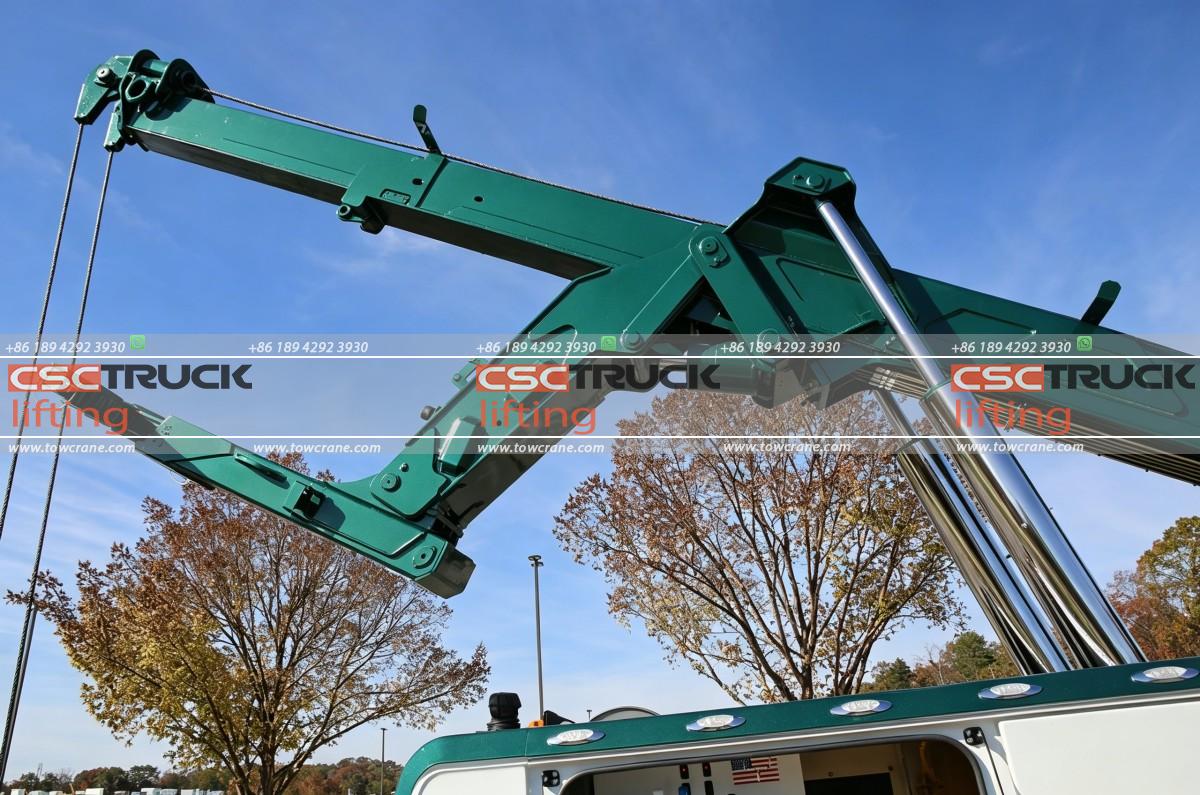
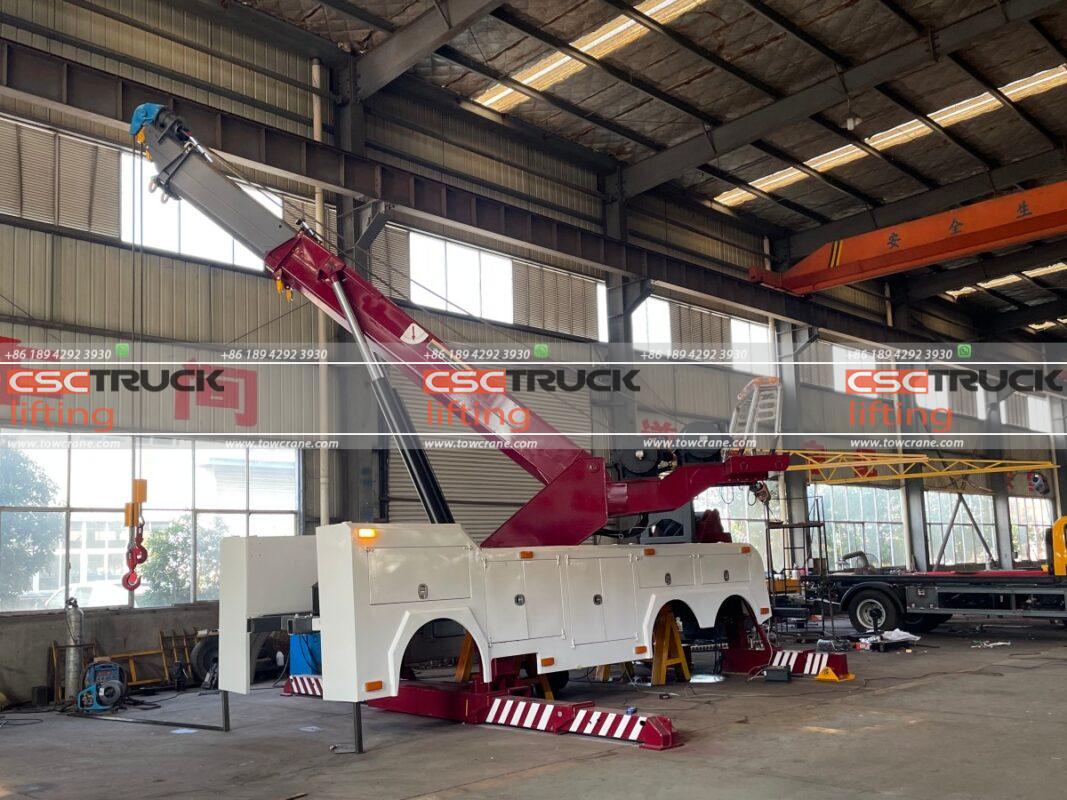
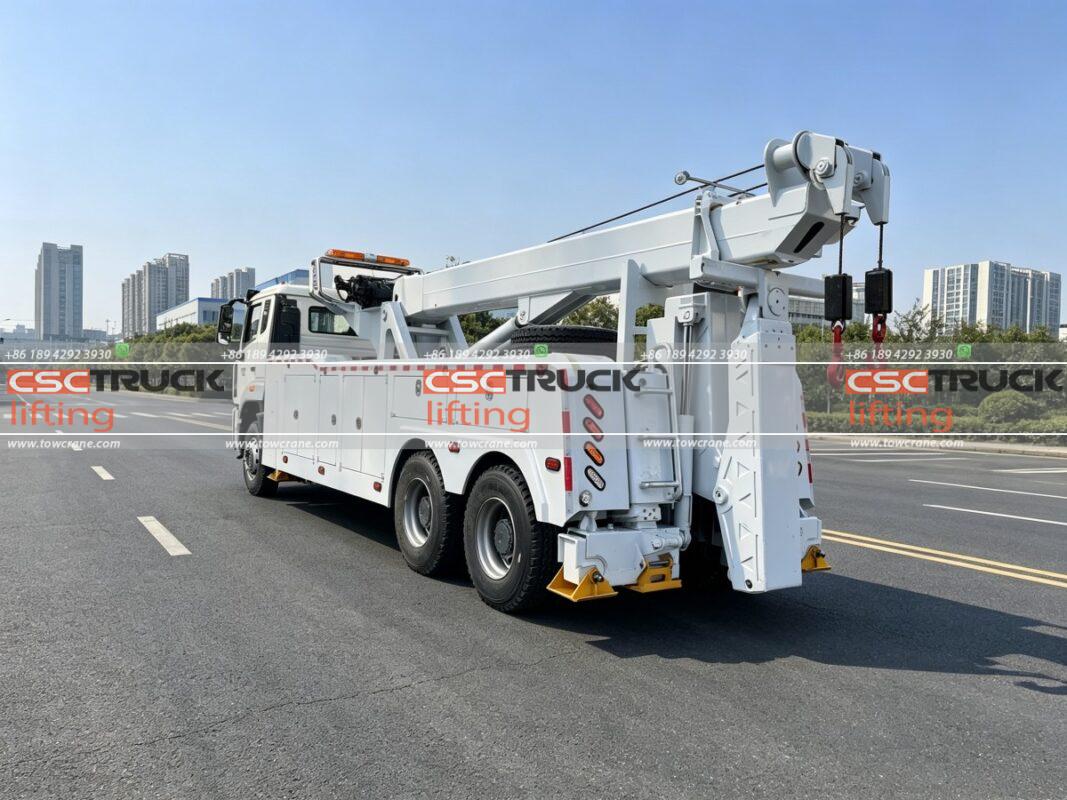
A wrecker boom is a heavy-duty structural arm installed at the rear of a recovery truck. It extends behind the vehicle and provides a working point for lifting and recovering disabled vehicles.
Depending on the design, a boom may be fixed, hydraulically adjustable, or telescopic. Hydraulic cylinders allow the operator to raise, lower, or adjust the boom, while a telescopic section can extend its working reach.
The boom itself does not normally pull the vehicle. Instead, it supports and positions the recovery winch and wire rope, allowing the winch to apply pulling force from a suitable angle.
How Does a Wrecker Boom Work?
The basic working principle of a wrecker boom is based on hydraulic power and controlled mechanical movement.
The truck engine provides power to a hydraulic pump through a PTO (Power Take-Off). The pump pressurizes hydraulic oil and sends it through control valves to hydraulic cylinders connected to the boom.
When the operator activates the boom controls, hydraulic pressure causes the cylinders to extend or retract. This changes the boom’s angle and position.
The basic power path is:
Engine → PTO → Hydraulic Pump → Control Valve → Hydraulic Cylinder → Boom Movement
The operator can raise or lower the boom and, depending on the design, extend or retract it. This provides precise control when positioning the recovery equipment.
At the same time, the winch controls the recovery cable. The boom provides the lifting and positioning structure, while the winch supplies the pulling force.
What Are the Main Parts of a Wrecker Boom?
A typical heavy-duty wrecker boom system includes several key components.
Boom Arm: The main structural component that supports the recovery load. It is engineered to withstand substantial lifting and bending forces.
Hydraulic Cylinders: These provide the force needed to raise, lower, or extend the boom.
Hydraulic Control Valves: They regulate hydraulic oil flow and allow the operator to control boom movement.
Winch: The winch winds the wire rope onto a drum and provides the pulling force needed to move the disabled vehicle.
Wire Rope and Hook: These connect the recovery system to an appropriate recovery point on the vehicle.
Sheave or Pulley: Usually positioned near the boom head, the sheave guides the wire rope and helps change its direction.
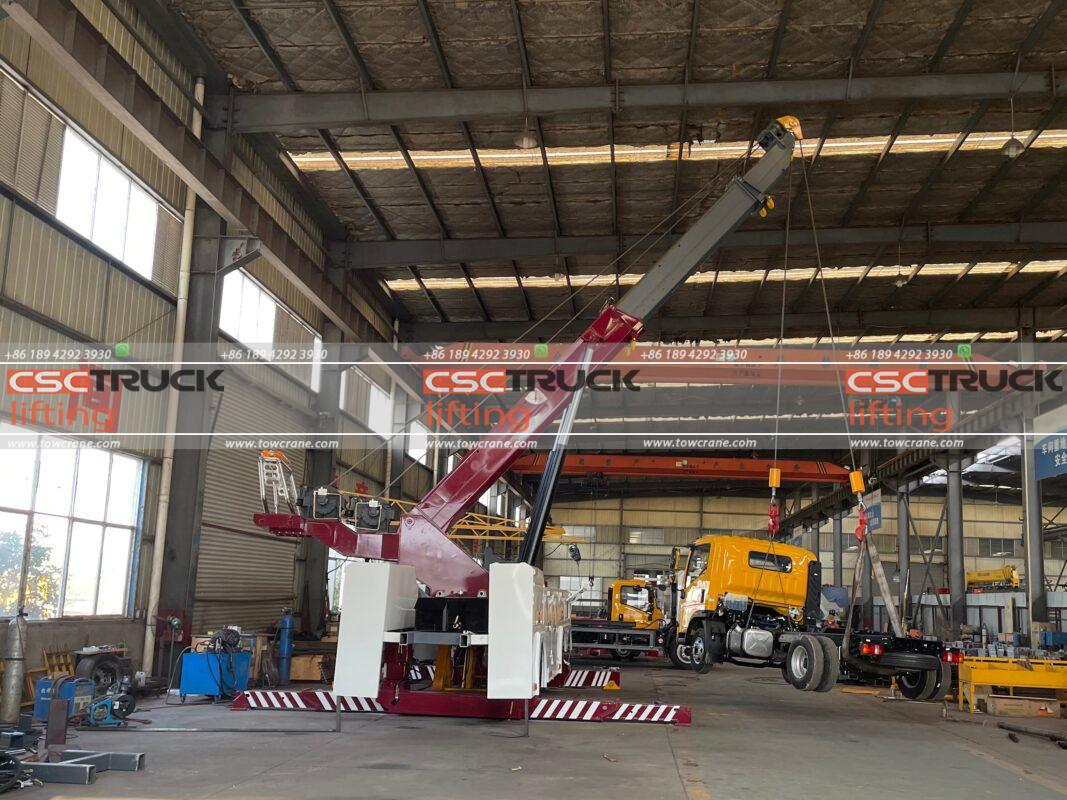
Stabilizers: Heavy-duty wreckers may use hydraulic stabilizers or outriggers to improve stability during demanding recovery operations.
How Does the Hydraulic System Move the Boom?
The hydraulic system is responsible for the controlled movement of the boom.
When the operator moves a control lever, hydraulic oil is directed into the appropriate cylinder. The pressure inside the cylinder creates linear force, causing the cylinder to extend or retract.
For example, when raising the boom, pressurized oil pushes the hydraulic cylinder outward. When lowering it, hydraulic flow is controlled in the opposite direction so that the boom moves downward smoothly.
This system allows the operator to make gradual adjustments instead of sudden movements. Such control is especially important when recovering heavy trucks, buses, trailers, and overturned vehicles.
What Is a Telescopic Wrecker Boom?
Some heavy-duty wreckers are equipped with a telescopic boom, which can extend and retract to change its working length.
A telescopic boom usually consists of multiple sections that slide within one another. Hydraulic cylinders control the extension of these sections.
When extended, the boom can reach vehicles positioned farther away from the recovery truck. When retracted, it provides a more compact configuration.
However, extending the boom also changes the load distribution and forces acting on the recovery truck. The available lifting capacity may therefore vary according to boom length and operating angle.
Operators should always follow the manufacturer’s rated capacity and load chart when using a telescopic boom.
How Does the Boom Work With the Winch?
The boom and winch perform different but complementary functions.
The boom provides lifting and positioning, while the winch provides pulling force.
During a typical recovery operation, the operator first positions the boom toward the disabled vehicle. The winch cable is then released and connected to an appropriate recovery point.
Once the cable is secured, the winch gradually pulls the vehicle. At the same time, the boom can be adjusted to maintain a suitable lifting angle and cable position.
This combination gives a heavy-duty wrecker tow truck much greater recovery flexibility than a basic towing vehicle.
For example, when recovering a truck from a ditch, the boom can provide a suitable lifting position while the winch gradually pulls the vehicle toward stable ground.
How Does a Wrecker Recover an Overturned Truck?
Recovering an overturned truck is one of the most demanding applications for a wrecker boom.
The recovery truck is positioned at a suitable location, and stabilizers may be deployed to improve stability. The operator then positions the boom and connects recovery cables to suitable points on the overturned vehicle.
One or more winches can be used depending on the recovery configuration. The winches provide controlled pulling force, while the boom helps position the cables and provide lifting support.
The operator must carefully control the recovery process because a heavy overturned vehicle can move unpredictably. Factors such as vehicle weight, boom position, cable angle, ground conditions, and wrecker stability all need to be considered.
What Determines Wrecker Boom Capacity?
Boom lifting capacity is a critical specification when choosing a wrecker tow truck.
The rated capacity depends on factors such as:
Boom structure and strength
Hydraulic cylinder capacity
Boom angle
Boom extension length
Chassis configuration
Stabilizer design
Importantly, the maximum rated capacity may not be available at every boom position. As the boom extends farther or operates at a different angle, the effective lifting capacity can change.
For this reason, operators should follow the manufacturer’s load chart rather than assuming the maximum rated capacity applies to every recovery situation.
Why Are Hydraulic Booms Important for Heavy-Duty Recovery?
Hydraulic booms provide a combination of high lifting force, precise control, and operational flexibility.
They allow operators to adjust the boom position according to the recovery situation and can be integrated with winches, stabilizers, wheel lifts, and other recovery equipment.
This flexibility is particularly useful for professional recovery companies handling different types of vehicles. A single heavy-duty wrecker may be used for highway accidents, commercial truck recovery, ditch recovery, trailer recovery, and other emergency operations.
How to Choose the Right Wrecker Boom
When selecting a wrecker tow truck, the boom should be considered as part of the complete recovery system.
Key factors include lifting capacity, working radius, boom length, telescopic range, hydraulic system capacity, winch capacity, chassis configuration, and stabilizer design.
The intended application is equally important. A wrecker designed for passenger vehicles does not require the same boom capacity as one designed to recover semi-trucks, buses, trailers, or construction equipment.
Choosing a boom that matches the expected vehicle weight and recovery conditions can improve both efficiency and operational safety.
A Key Part of Heavy-Duty Vehicle Recovery
The boom is essentially the lifting and positioning backbone of a wrecker tow truck. Hydraulic cylinders provide controlled movement, while winches and recovery cables generate the pulling force needed to move disabled vehicles.
Together, these systems allow heavy-duty wreckers to handle complex recovery operations that conventional tow trucks may not be able to perform.
For professional vehicle recovery businesses, CSCTRUCK Towcrane provides heavy-duty wrecker and towing solutions equipped with powerful hydraulic systems, recovery winches, and robust boom structures for demanding commercial vehicle recovery applications.